PRÁTICA COM QUESTÕES OFICIAIS
Questão 5 (Inglês) do ITA 2017
Texto-base das questões 01 a 07 · Inglês
As questões de 1 a 7 referem-se ao texto a seguir:
FRAYING AT THE EDGES: A LIFE-CHANGING DIAGNOSIS
IT BEGAN WITH what she saw in the bathroom mirror. On a dull morning, Geri Taylor padded into the shiny bathroom of her Manhattan apartment. She casually checked her reflection in the mirror, doing her daily inventory. Immediately, she stiffened with fright.
Huh? What?
She didn’t recognize herself.
She gazed saucer-eyed at her image, thinking: Oh, is this what I look like? No, that’s not me. Who’s that in my mirror?
This was in late 2012. She was 69, in her early months getting familiar with retirement. For some time she had experienced the sensation of clouds coming over her, mantling thought. There had been a few hiccups at her job. She had been a nurse who climbed the rungs to health care executive. Once, she was leading a staff meeting when she had no idea what she was talking about, her mind like a stalled engine that wouldn’t turn over.
“Fortunately I was the boss and I just said, ‘Enough of that; Sally, tell me what you’re up to,’” she would say of the episode.
Certain mundane tasks stumped her. She told her husband, Jim Taylor, that the blind in the bedroom was broken. He showed her she was pulling the wrong cord. Kept happening. Finally, nothing else working, he scribbled on the adjacent wall which cord was which.
Then there was the day she got off the subway at 14th Street and Seventh Avenue unable to figure out why she was there.
So, yes, she had had inklings that something was going wrong with her mind. She held tight to these thoughts. She even hid her suspicions from Mr. Taylor, who chalked up her thinning memory to the infirmities of age.
“I thought she was getting like me,” he said. “I had been forgetful for 10 years.”
But to not recognize her own face! To Ms. Taylor, this was the “drop-dead moment” when she had to accept a terrible truth. She wasn’t just seeing the twitches of aging but the early fumes of the disease.
She had no further issues with mirrors, but there was no ignoring that something important had happened. She confided her fears to her husband and made an appointment with a neurologist.
“Before then I thought I could fake it,” she would explain. “This convinced me I had to come clean.”
In November 2012, she saw the neurologist who was treating her migraines. He listened to her symptoms, took blood, gave her the Mini Mental State Examination, a standard cognitive test made up of a set of unremarkable questions and commands. (For instance, she was asked to count backward from 100 in intervals of seven; she had to say the phrase: “No ifs, ands or buts”; she was told to pick up a piece of paper, fold it in half and place it on the floor beside her.)
He told her three common words, said he was going to ask her them in a little bit. He emphasized this by pointing a finger at his head — remember those words. That simple. Yet when he called for them, she knew only one: Beach. In her mind, she would go on to associate it with the doctor, thinking of him as Dr. Beach.
He gave a diagnosis of mild cognitive impairment, a common precursor to Alzheimer’s disease. The first label put on what she had. Even then, she understood it was the footfall of what would come. Alzheimer’s had struck her father, a paternal aunt and a cousin. She long suspected it would eventually find her.
Fonte: http://www.nytimes.com/interactive/2016/05/01/nyregion/living-with-alzheimers.html?action=click&contentCollection=Americas&module=Trending&version=Full®ion= Marginalia&pgtype=article. (acesso em 1/05/2016).
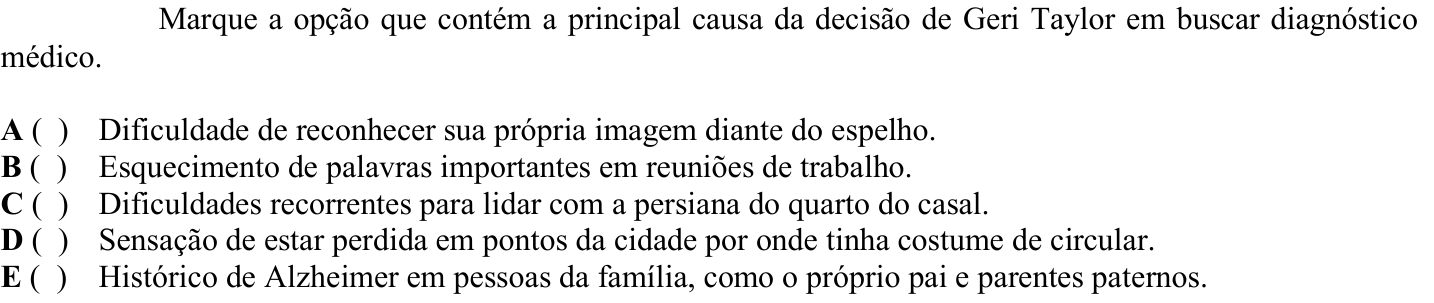
Marque a opção que contém a principal causa da decisão de Geri Taylor em buscar diagnóstico médico.
- ADificuldade de reconhecer sua própria imagem diante do espelho.
- BEsquecimento de palavras importantes em reuniões de trabalho.
- CDificuldades recorrentes para lidar com a persiana do quarto do casal.
- DSensação de estar perdida em pontos da cidade por onde tinha costume de circular.
- EHistórico de Alzheimer em pessoas da família, como o próprio pai e parentes paternos.
Você já respondeu questões neste aparelho. Crie sua conta grátis para guardar o histórico e refazer as que errou.
Resposta salva no seu histórico.
Reportar erro na questão
Resolução comentada
A pergunta pede a principal causa da decisão de Geri de procurar um médico. O texto apresenta vários sinais de que algo estava errado, mas só um deles é apontado como o ponto de virada.
Os sinais anteriores foram:
- Na reunião de trabalho, ela não sabia sobre o que falava.
- Ela se confundia com o cordão da persiana do quarto.
- Ela desceu do metrô na 14th Street sem saber por que estava ali.
Em todos esses casos, ela guardou as suspeitas para si e até as escondeu do marido, que atribuía o esquecimento à idade.
Depois vem o episódio do espelho. O texto diz que, ao não reconhecer o próprio rosto, foi o "drop-dead moment", em que ela teve de aceitar uma "terrível verdade". Em seguida, ela contou seus medos ao marido e marcou consulta com um neurologista. Ela mesma explica: "Before then I thought I could fake it. This convinced me I had to come clean" ("Antes disso, eu achava que podia fingir. Isso me convenceu de que eu tinha de abrir o jogo").
O histórico familiar de Alzheimer existe, mas ela já o conhecia havia muito tempo e ele não a levou ao médico. Ele só aparece no fim do texto, depois do diagnóstico.
A causa decisiva foi não reconhecer a própria imagem no espelho.
Alternativa A.
Pegadinha: A alternativa E engana por ser um dado real do texto, o histórico familiar de Alzheimer, mas ele não foi o que a levou ao médico. As alternativas B, C e D também citam sintomas reais que vieram antes do episódio do espelho.
Por que as outras alternativas estão erradas
- BO lapso na reunião foi um dos sinais, mas ela o contornou e continuou escondendo o problema; além disso, não foi esquecimento de palavras.
- CA confusão com o cordão da persiana foi só mais um sintoma, resolvido pelo marido com um rabisco na parede, sem levá-la ao médico.
- DO episódio do metrô foi um sinal anterior, não o momento que a convenceu a buscar ajuda.
- EO histórico familiar é mencionado só no fim, como contexto do medo dela, e não como o motivo da consulta.
Assunto: Informações explícitas e detalhes.
Reportar erro na resolução
Ver como caiu na prova
Fonte: ITA 2017 · Inglês. Prova oficial ↗