PRÁTICA COM QUESTÕES OFICIAIS
Questão 17 (Inglês) do ITA 2017
Texto-base das questões 17 a 20 · Inglês
As questões de 17 a 20 referem-se ao texto a seguir:
STARSHOT PROJECT: STEPHEN HAWKING AND MARK ZUCKERBERG LAUNCH
MOST AMBITIOUS ALIEN-FINDING PROJECT EVER
Tiny rockets are going to be sent into space to study the far universe in the most ambitious space exploration project in history.
Scientists including Stephen Hawking and backers such as internet investor Yuri Milner and Mark Zuckerberg will send “nano craft” deep into space to explore the most remote regions that humans have ever seen, by far.
The hugely ambitious project could reveal deep secrets of the universe and will allow people to photograph one of the most likely places to hold life on other worlds.
Professor Hawking said at the event: "What makes us unique is transcending our limits. Gravity pins us to the ground, but I just flew to America.
"How do we transcend these limits? With our minds and our machines.
"The limit that confronts us now is the great void between us and the stars. But now we can transcend it, with light beams, light sails, and the lightest spacecraft ever built. Today we commit to this next great leap into the cosmos, because we are human and our nature is to fly.”
The Starshot Project hopes to get the tiny robots out to the Alpha Centauri star system, 25 trillion miles away. Getting there through normal means would take 30,000 years – but the new project hopes that using the tiny rockets will allow them to get there in just 20.
Scientists think that the Alpha Centauri system might well have an Earth-like planet that could be found in its “habitable zones”. The craft will be able to take pictures of those – a potential way that they might find life on other worlds.
The crafts will be “gram-scale nano craft”, according to Yuri Milner, which will make their way through space using a “sail pushed by a light beam”. Their design will allow them to fly at 25 per cent of light speed.
Those craft will be able to send back images of possible planets and other scientific data, according to the scientists behind it.
"The human story is one of great leaps,” Dr Milner said. “Today we are preparing for the next great leap – to the stars.
"Can we literally reach the stars, and can we do it in our lifetime?"
The tiny rockets are made up of computers that can be mounted to a tiny “wafer”. Shrinking computer components mean that all of the necessary parts – cameras, thrusters, power supply and navigation equipment – can all be mounted on a tiny plate that will be a fully functional space probe.
Before those are built, the project will have to create all of the important parts on the ground. That includes the construction of a light-beamer that can power the rockets and a “mothership” that will be able to carry them all out into space and launch them.
Because of economies of scale and the decreasing price of computer components, the team will eventually be able to send out the rockets for just a few hundred thousand dollars, they said.
Fonte: http://www.independent.co.uk/news/science/starshot-project-stephen-hawking-and-mark-zuckerberg-to-send-tiny-rockets-to-alpha-centauri-in-most-a6981101.html (acesso em 03/05/2016).
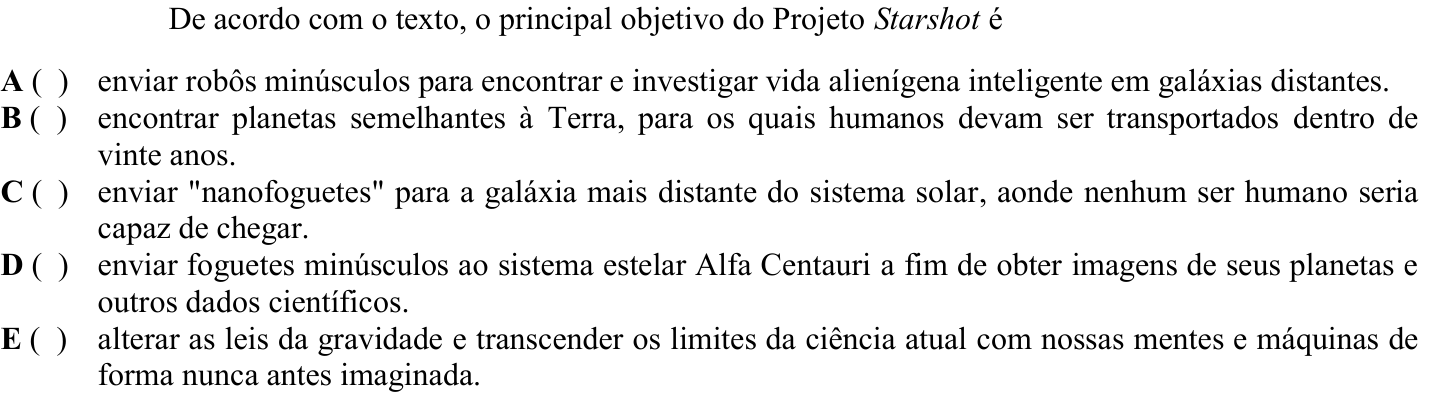
De acordo com o texto, o principal objetivo do Projeto Starshot é
- Aenviar robôs minúsculos para encontrar e investigar vida alienígena inteligente em galáxias distantes.
- Bencontrar planetas semelhantes à Terra, para os quais humanos devam ser transportados dentro de vinte anos.
- Cenviar "nanofoguetes" para a galáxia mais distante do sistema solar, aonde nenhum ser humano seria capaz de chegar.
- Denviar foguetes minúsculos ao sistema estelar Alfa Centauri a fim de obter imagens de seus planetas e outros dados científicos.
- Ealterar as leis da gravidade e transcender os limites da ciência atual com nossas mentes e máquinas de forma nunca antes imaginada.
Você já respondeu questões neste aparelho. Crie sua conta grátis para guardar o histórico e refazer as que errou.
Resposta salva no seu histórico.
Reportar erro na questão
Resolução comentada
A questão pede o objetivo central do projeto, então procure no texto o que será enviado, para onde e para quê.
-
O quê: "tiny rockets" / "gram-scale nano craft", ou seja, foguetes minúsculos, de escala de gramas.
-
Para onde: o texto diz que o projeto "hopes to get the tiny robots out to the Alpha Centauri star system", que fica a 25 trilhões de milhas. Trata-se de um sistema estelar, e não de uma galáxia distante.
-
Para quê: "The craft will be able to take pictures of those [planets]" e "send back images of possible planets and other scientific data". Ou seja, fotografar planetas e enviar dados científicos. Isso pode ajudar a encontrar sinais de vida, mas vida é apenas uma possibilidade ("a potential way").
A alternativa D reúne os três pontos: foguetes minúsculos, sistema Alfa Centauri, imagens dos planetas e outros dados científicos.
As demais extrapolam o texto. Falam em vida inteligente, em galáxias, em transportar humanos em vinte anos ou em alterar a gravidade, e nada disso aparece.
Alternativa D.
Por que as outras alternativas estão erradas
- AO texto não fala em vida inteligente nem em galáxias distantes; Alfa Centauri é um sistema estelar e a vida é só uma possibilidade.
- BOs 20 anos são o tempo de viagem das sondas, não de transportar humanos; só se enviam robôs.
- CAlfa Centauri é um sistema estelar próximo, não a galáxia mais distante do sistema solar.
- EHawking fala em transcender limites, mas o projeto não pretende alterar as leis da gravidade.
Assunto: Ideia central e finalidade do texto.
Reportar erro na resolução
Ver como caiu na prova
Fonte: ITA 2017 · Inglês. Prova oficial ↗