PRÁTICA COM QUESTÕES OFICIAIS
Questão 2 (Inglês) do ITA 2016
Texto-base das questões 01 a 07 · Inglês
As questões de 1 a 7 referem-se ao texto a seguir:
Brazil’s business Belindia – Why the country produces fewer world-class companies than it should BRAZILIANS make up almost 3% of the planet’s population and produce about 3% of its output. Yet of the firms in Fortune magazine’s 2014 “Global 500” ranking of the biggest companies by revenue only seven, or 1.4%, were from Brazil, down from eight in 2013. And on Forbes’s list of the 2,000 most highly valued firms worldwide just 25, or 1.3%, were Brazilian. The country’s biggest corporate “star”, Petrobras, is mired in scandals, its debt downgraded to junk status. In 1974 Edmar Bacha, an economist, described its economy as “Belindia”, a Belgium-sized island of prosperity in a sea of India-like poverty. Since then Brazil has done far better than India in alleviating poverty, but in business terms it still has a Belindia problem: a handful of world-class enterprises in a sea of poorly run ones. Brazilian businesses face a litany of obstacles: bureaucracy, complex tax rules, shoddy infrastructure and a shortage of skilled workers—to say nothing of a stagnant economy. But a big reason for Brazilian firms’ underperformance is less well rehearsed: poor management. Since 2004 John van Reenen of the London School of Economics and his colleagues have surveyed 11,300 midsized firms in 34 countries, grading them on a five-point scale based on how well they monitor their operations, set targets and reward performance. Brazilian firms’ average score, at 2.7, is similar to that of China’s and a bit above that of India’s. But Brazil ranks below Chile (2.8) and Mexico (2.9); America leads the pack with 3.3. The best Brazilian firms score as well as the best American ones, but its long tail of badly run ones is fatter. Part of the explanation is that medium and large firms tend to be better-organised than small ones, and not only because well-run ones are likelier to grow. Brazil offers incentives aplenty to stay bitty, such as preferential tax treatment for firms with a turnover of no more than 3.6m reais ($1.3m). As they expand, many firms split rather than face increased scrutiny from the taxman. According to the World Bank, a midsized Brazilian firm spends 2,600 hours filing taxes each year. In Mexico, it is 330 hours. Ownership patterns play a part too. Many Brazilian concerns are controlled by an individual shareholder, or one or two families. Two-thirds of those with sales of more than $1 billion a year are family-owned, notes Heinz-Peter Elstrodt of McKinsey, a consulting firm. That is less than in Mexico (96%) or South Korea (84%) but more than in America or Europe. Mr Van Reenen’s research shows that where family owners plump for outside chief executives, their firms do no worse than similarly sized ones with more diverse shareholders. But all too often they pick kin over professional managers—and performance suffers. This is particularly true in “low-trust” societies like Brazil, where bosses hire relatives instead of better-qualified strangers to avoid being robbed or sued for falling foul of overly worker-friendly labour laws. Decades of economic turmoil—which ended when hyperinflation was vanquished in 1994—meant that companies were managed from crisis to crisis. This forced Brazilian firms to be nimble. But it also encouraged short-termism, which management consultants and academics finger as Brazilian managers’ number-one sin. Faced with a record drought in 2014, and a subsequent spike in energy prices in a hydropower-dependent country, Usiminas, a steelmaker, stopped smelting and started selling power it had bought on cheap long-term contracts. Energy sales made up most of its operating profits that year. Such short-term stunts are hardly the path to long-term greatness. Worse, crisis management all too often consists of going cap in hand to the government. Brazilian bosses continue to waste hours in meetings with politicians that could be better spent improving their businesses. In January 2014, as vehicle sales flagged, the automotive industry’s reflex reaction was to descend on the capital, Brasília, and demand an extension of its costly tax breaks. Thanks to lifelines cast by the state, feeble firms stay afloat rather than sink and make room for more agile competitors. Shielded from competition by tariffs, subsidies and local-content rules, they have little reason to innovate. A locally invented gizmo which lets cars run on both petrol and biodiesel is nifty. But, asks Marcos Lisboa of Insper, a business school, does that really justify six decades of public support for the motor industry? The dead hand of government Indeed, a glance at the “Belgian” end of Brazil’s corporate landscape suggests that successful firms cluster in sectors the state has not tried desperately to help, such as retail or finance. Bradesco, a big lender, is internationally praised as a pioneer of automated banking. Each month Arezzo creates 1,000 new models of women’s shoes, and picks 170-odd to sell in its shops. Brazil’s other world-beaters are in industries like agriculture and aerospace, which are free to compete at home and abroad, and in which the government sticks to its proper role. In 1990 farms were allowed to consolidate and to buy foreign machines, pesticides and fertiliser. Efforts by Brazil’s trade negotiators opened up export markets. JBS, a meat giant, can slaughter 100,000 head of cattle a day, selling more beef than any rival worldwide. Thanks in part to Embrapa, the national agriculture-research agency, Brazilian farms have been raising productivity by about 4% a year for two decades. Similarly, a supply of skilled engineers and know-how from the government’s Technological Institute of Aeronautics has helped turn Embraer, privatised in 1994, into one of the world’s most successful aircraft-makers. The success of businesses such as these offers a lesson for the state. The best way to make Brazil’s underperforming firms more competitive would be to make them compete more. Coddling by the state can be more a curse than a blessing. Ronald Reagan’s dictum that the nine most terrifying words in the English language are, “I’m from the government and I’m here to help,” translates well into Flemish, Hindi and Brazilian Portuguese.
By Schumpeter. In: The Economist. Feb 28th,2015.
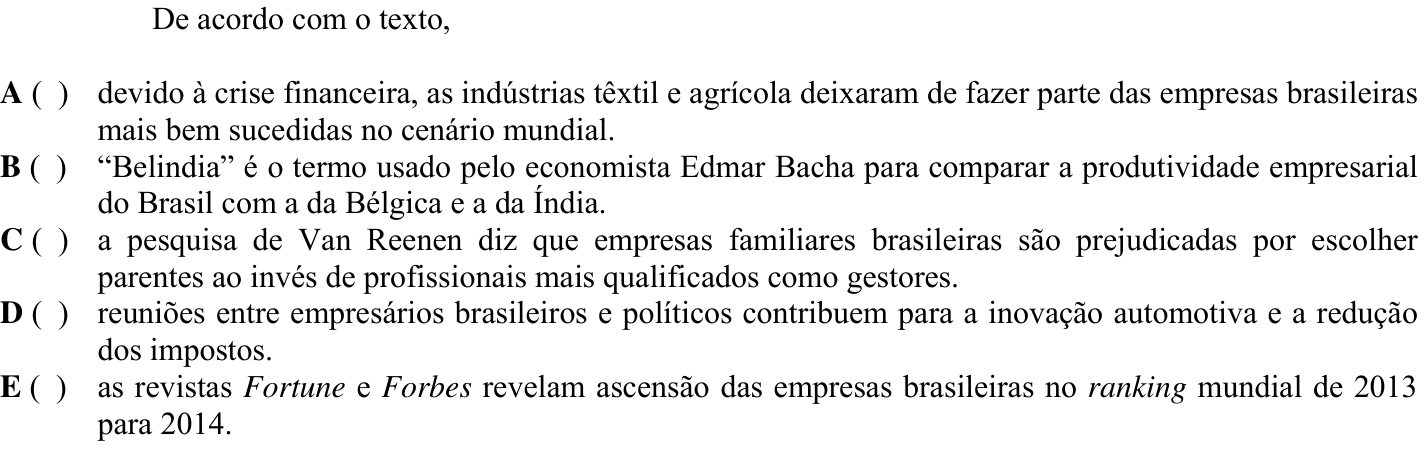
De acordo com o texto,
- Adevido à crise financeira, as indústrias têxtil e agrícola deixaram de fazer parte das empresas brasileiras mais bem sucedidas no cenário mundial.
- B“Belindia” é o termo usado pelo economista Edmar Bacha para comparar a produtividade empresarial do Brasil com a da Bélgica e a da Índia.
- Ca pesquisa de Van Reenen diz que empresas familiares brasileiras são prejudicadas por escolher parentes ao invés de profissionais mais qualificados como gestores.
- Dreuniões entre empresários brasileiros e políticos contribuem para a inovação automotiva e a redução dos impostos.
- Eas revistas Fortune e Forbes revelam ascensão das empresas brasileiras no ranking mundial de 2013 para 2014.
Você já respondeu questões neste aparelho. Crie sua conta grátis para guardar o histórico e refazer as que errou.
Resposta salva no seu histórico.
Reportar erro na questão
Resolução comentada
Vamos conferir cada alternativa com o que o texto diz.
- O texto diz que os setores bem-sucedidos são varejo, finanças, agricultura e aeroespacial. Não fala em crise que tenha tirado a indústria têxtil e a agrícola da lista. A agricultura, aliás, é citada como setor de sucesso.
- "Belindia" foi criado por Bacha em 1974 para descrever a economia brasileira: uma ilha de prosperidade do tamanho da Bélgica num mar de pobreza como o da Índia. A comparação é sobre riqueza e pobreza, não sobre produtividade empresarial.
- No quarto parágrafo, o texto diz que a pesquisa de Van Reenen mostra que, quando famílias contratam CEOs externos, as empresas não vão pior. Mas "all too often they pick kin over professional managers—and performance suffers" ("muitas vezes escolhem parentes em vez de gestores profissionais, e o desempenho sofre"). Isso confere com a alternativa C.
- As reuniões com políticos são descritas como perda de tempo, que serve para pedir benefícios fiscais. O texto não diz que contribuem para a inovação.
- Segundo o texto, o número de empresas brasileiras na Fortune caiu de 8 em 2013 para 7 em 2014. Não houve ascensão.
Alternativa C.
Por que as outras alternativas estão erradas
- AO texto não menciona crise que tenha afastado as indústrias têxtil e agrícola; a agricultura é citada como setor de sucesso.
- BBacha comparou prosperidade e pobreza da economia brasileira com Bélgica e Índia, não a produtividade empresarial.
- DO texto afirma que as reuniões com políticos desperdiçam tempo, e que a proteção estatal desestimula a inovação.
- EA Fortune mostra queda de 8 para 7 empresas brasileiras de 2013 para 2014, não ascensão.
Assunto: Informações explícitas e detalhes.
Reportar erro na resolução
Ver como caiu na prova
Fonte: ITA 2016 · Inglês. Prova oficial ↗