PRÁTICA COM QUESTÕES OFICIAIS
Questão 11 (Inglês) do ITA 2015
Texto-base das questões 11 a 17 · Inglês
As questões de 11 a 17 referem-se ao texto a seguir:
STICKERNOMICS
Football albums
Got, got, got, got, got, need
THE World Cup is still two weeks away, but for children worldwide (plus disturbing numbers of adults) the race to complete the Brazil 2014 sticker book started long ago. Panini, an Italian firm, has produced sticker albums for World Cups since Mexico 1970; this year’s version has 640 stickers to collect. Collecting them is no idle pursuit, however. Getting every slot filled delivers an early lesson in probability, the value of statistical tests and the importance of liquidity.
When you start an album, your first sticker (in Britain, they come in packs of five) has a 640/640 probability of being needed. As the spaces get filled, the odds of opening a pack and finding a sticker you want fall. According to Sylvain Sardy and Yvan Velenik, two mathematicians at the University of Geneva, the number of sticker packs that you would have to buy on average to fill the album by mechanically buying pack after pack would be 899. That assumes there is no supply shock to the market (the theft of hundreds of thousands of stickers in Brazil in April left many fearful that Panini would run short of cards).
It also assumes that the market is not being rigged. Panini says that each sticker is printed in the same volumes and randomly distributed. In a 2010 paper Messrs Sardy and Velenik gamely played the role of “regulator” by checking the distribution of stickers for a 660-sticker album sold in Switzerland for that year’s World Cup. Out of their sample of 6,000 stickers, they expected to see each sticker 9.09 times on average (6,000/660), which was broadly borne out in practice.
Even in a fair market, it is inefficient to buy endless packs as an individual (not to mention bloody expensive for the parents). The answer is to create a market for collectors to swap their unwanted stickers. The playground is one version of this market, where a child who has a card prized by many suddenly understands the power of limited supply. Sticker fairs are another. As with any market, liquidity counts. The more people who can be attracted into the market with their duplicate cards, the better the chances of finding the sticker you want.
Messrs Sardy and Velenik reckon that a group of ten astute sticker-swappers would need a mere 1,435 packs between them to complete all ten albums, if they take advantage of Panini’s practice of selling the final 50 missing stickers to order. Internet forums, where potentially unlimited numbers of people can swap stickers, make this number fall even further. The idea of a totally efficient market should dismay Panini, which will sell fewer packs as a result. But as in all markets, behaviour is not strictly rational. Despite entreaties, your correspondent’s son is prepared to tear out most of his stickers to get hold of Lionel Messi.
Fonte: http://www.economist.com/news/finance-and-economics/21603019-got-got-got-got-got-need-stickernomics
Acesso: 13/ago/2014
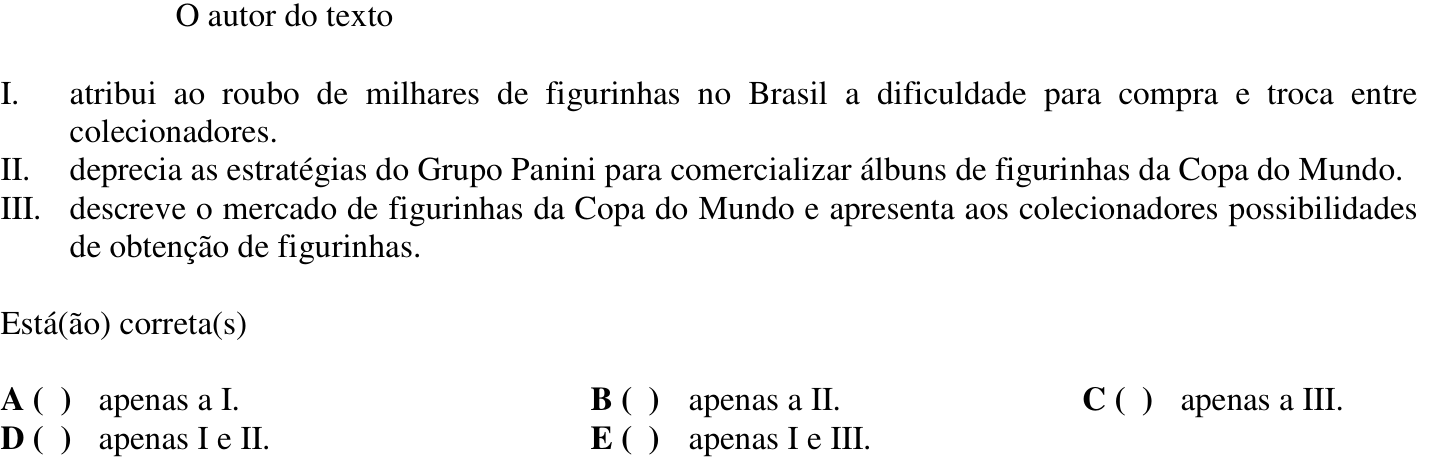
O autor do texto
I. atribui ao roubo de milhares de figurinhas no Brasil a dificuldade para compra e troca entre colecionadores.
II. deprecia as estratégias do Grupo Panini para comercializar álbuns de figurinhas da Copa do Mundo.
III. descreve o mercado de figurinhas da Copa do Mundo e apresenta aos colecionadores possibilidades de obtenção de figurinhas.
Está(ão) correta(s)
- Aapenas a I.
- Bapenas a II.
- Capenas a III.
- Dapenas I e II.
- Eapenas I e III.
Você já respondeu questões neste aparelho. Crie sua conta grátis para guardar o histórico e refazer as que errou.
Resposta salva no seu histórico.
Reportar erro na questão
Resolução comentada
Vamos testar cada afirmação contra o texto.
I. O texto menciona o roubo de centenas de milhares de figurinhas no Brasil em abril apenas como um possível "choque de oferta" (supply shock): muitos temiam que a Panini ficasse sem figurinhas. O cálculo de 899 pacotes assume que esse choque não existe. Nada diz que o roubo dificultou compra e troca entre colecionadores. A afirmação distorce o texto e está errada.
II. O autor não desvaloriza as estratégias da Panini. Ele cita, sem crítica, que as figurinhas são impressas em mesmo volume e distribuídas aleatoriamente, e que a empresa vende por encomenda as 50 últimas. O tom é de análise econômica com humor, não de depreciação. Errada.
III. O texto descreve o mercado: probabilidade de achar figurinhas novas, média de 899 pacotes, verificação da distribuição pelos matemáticos. Também apresenta formas de completar o álbum: trocas no pátio da escola, feiras de figurinhas, fóruns na internet e compra por encomenda das 50 finais. Correta.
Só a III procede.
Alternativa C.
Pegadinha: A alternativa E engana porque o roubo das figurinhas é mesmo citado, mas como hipótese de falta de oferta, não como obstáculo às trocas.
Por que as outras alternativas estão erradas
- AO roubo aparece só como temor de falta de oferta, não como causa de dificuldade na compra e troca; e omite a III, correta.
- BO autor não deprecia a Panini; apenas descreve suas práticas de forma neutra.
- DReúne duas afirmações falsas (I e II) e exclui a III, que é a correta.
- EAcerta a III, mas inclui a I, que distorce o papel do roubo no texto.
Assuntos: Ideia central e finalidade do texto, Informações explícitas e detalhes.
Reportar erro na resolução
Ver como caiu na prova
Fonte: ITA 2015 · Inglês. Prova oficial ↗