PRÁTICA COM QUESTÕES OFICIAIS
Questão 16 (Inglês) do ITA 2014
Texto-base das questões 13 a 20 · Inglês
As questões de 13 a 20 referem-se ao texto a seguir:
DISTANT PEAK CAR
Carmakers worry that one day demand for cars will stop rising. But that is a long way off.
IN 1924 FORD ran an advertisement headlined “His First Car”, urging fathers to buy their teenage sons their first set of wheels. The idea caught on. For boys, especially, learning to drive became an essential part of growing up. By the late 1970s 86% of American 18-year-olds—of both sexes—had a driving licence. But then the trend went into reverse: researchers at the University of Michigan found that in 2010 only 61% of 18-year-old Americans had licences. Other rich countries are going the same way. Teenagers are showing less interest in cars as they turn their attention to smartphones and social networking.
This is a worry for carmakers, who are wondering where their future customers are going to come from. In the two decades to 2008 the number of miles driven by Americans in their 20s fell by 8%. In Britain a study for the RAC Foundation, a transport-research body, found a 30% drop among men in the same age group between 1996 and 2006.
One reason for concern is that half the world’s population now lives in towns and cities, which have only so much space for cars. Even in rapidly growing car markets such as China, city governments in the more prosperous parts of the country are beginning to restrict new car registrations and invest heavily in public transport.
Young urban residents may also be meeting up less often in person, thanks to social-networking sites that let them keep in touch digitally. So they have less need for a car, and when they do need one they turn to car clubs, which offer rental by the hour in their neighbourhood, and to car-sharing schemes. In particular, the generation who came of age after 2000, the so-called “millennials”, express a preference for having access to rather than owning cars. But some of that may be just talk. In a survey by McKinsey, American millennials said they expected to use car clubs in the future, but when asked if owning a car would remain an important status symbol, they were much more likely to answer “yes” than older consumers.
Economic factors, too, work against car ownership. Sheryl Connelly, Ford’s “global trends and futuring” manager, notes that a few decades ago teenagers in America often got free driving lessons at school, but now they may have to pay up to $800 for them before they can sit their test. The cost of adding a young driver to the family’s car-insurance policy too has risen sharply, she says. In Britain the RAC Foundation study found that fewer young men are driving because their employers have cut back on providing company cars.
However, studies also show a marked rise in the proportion of elderly people with driving licences. Baby- boomers pretty much all learned to drive, and now that they are beginning to retire they expect to continue motoring. The development of assisted driving, followed one day by fully automated cars, will allow them to stay mobile for much longer.
What may be happening in rich countries is a one-off shift in the timing of people’s driving careers, so that they start later but then continue well into old age. This may be no bad thing for carmakers. It has long been an open secret in the business that cars are advertised as being for the young but are bought mainly by the middle-aged with the necessary disposable income. In America the average Mercedes buyer is in his late 50s, and even the supposedly youth-oriented MINI Cooper is typically bought by people in their early 40s. The world’s biggest car markets—China, North America and Europe—are all greying.
So it is not clear that declining car ownership among young urbanites will have more than a marginal effect on overall car sales. Besides, argues Renault-Nissan’s Mr Ghosn, for most people “their car is more than an object.” For some it is an extension of their home, he says, and most people would rather not share their home. For others it is their pet, and who wants to share their pet?
All in all, “peak car”—the point at which worldwide demand for cars will stop rising—still seems quite a long way off. In the rich world some of the economic factors that have deterred young people from taking up driving will fade away: as cars become increasingly self-piloting and accident rates fall, insurance costs should decrease, and in time there will be little or no need to take expensive lessons.
The Economist, April 20th, 2013.
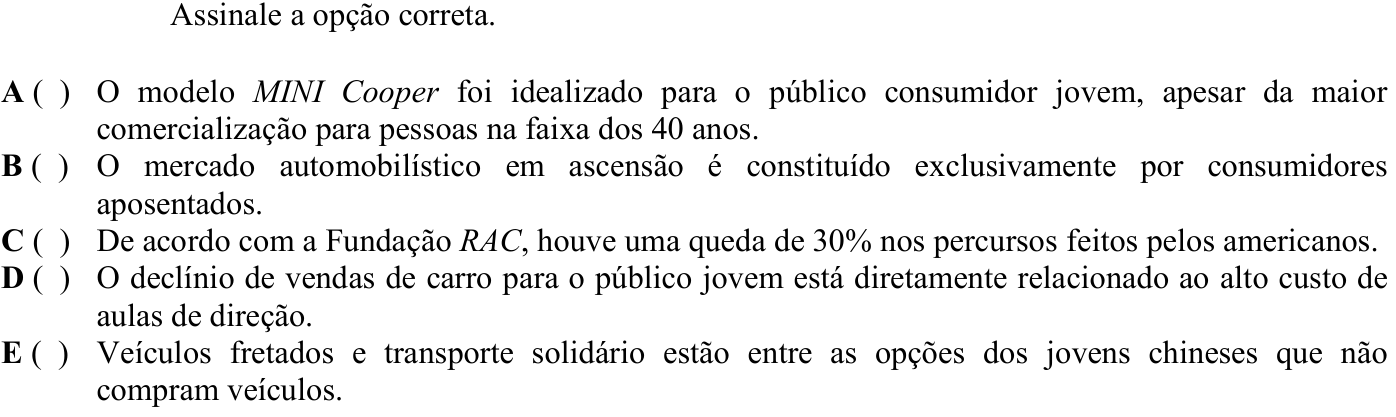
Assinale a opção correta.
- AO modelo MINI Cooper foi idealizado para o público consumidor jovem, apesar da maior comercialização para pessoas na faixa dos 40 anos.
- BO mercado automobilístico em ascensão é constituído exclusivamente por consumidores aposentados.
- CDe acordo com a Fundação RAC, houve uma queda de 30% nos percursos feitos pelos americanos.
- DO declínio de vendas de carro para o público jovem está diretamente relacionado ao alto custo de aulas de direção.
- EVeículos fretados e transporte solidário estão entre as opções dos jovens chineses que não compram veículos.
Você já respondeu questões neste aparelho. Crie sua conta grátis para guardar o histórico e refazer as que errou.
Resposta salva no seu histórico.
Reportar erro na questão
Resolução comentada
Vamos conferir cada alternativa com o texto.
O trecho decisivo está no penúltimo bloco sobre carros e idade: "cars are advertised as being for the young but are bought mainly by the middle-aged" e "even the supposedly youth-oriented MINI Cooper is typically bought by people in their early 40s". Ou seja, o MINI Cooper é supostamente voltado ao público jovem ("youth-oriented"), mas é comprado sobretudo por pessoas na casa dos 40 anos. Isso é exatamente o que diz a alternativa A.
As demais falham:
- O texto diz que os mercados estão "greying" (envelhecendo), mas não que sejam formados exclusivamente por aposentados.
- A queda de 30% citada pela RAC Foundation refere-se a homens jovens britânicos entre 1996 e 2006, não a americanos.
- O custo das aulas é apenas um dos fatores econômicos (junto com seguro, smartphones, urbanização e corte de carros de empresa), então não há relação "direta" única.
- A China aparece só como mercado em crescimento cujas cidades restringem registros de carros; car clubs e car-sharing são mencionados para jovens urbanos em geral, não especificamente chineses.
Alternativa A.
Pegadinha: A alternativa C engana ao trocar britânicos por americanos, mantendo o número 30% e a RAC Foundation, que aparecem no texto.
Por que as outras alternativas estão erradas
- BO texto diz que os mercados estão envelhecendo, não que sejam formados exclusivamente por aposentados.
- CA queda de 30% se refere a homens jovens britânicos (1996-2006), não aos americanos.
- DO custo das aulas é só um dos vários fatores citados; afirmar relação direta e única é exagero.
- ECar clubs e car-sharing são citados para jovens urbanos em geral, não especificamente para chineses.
Assunto: Informações explícitas e detalhes.
Reportar erro na resolução
Ver como caiu na prova
Fonte: ITA 2014 · Inglês. Prova oficial ↗