PRÁTICA COM QUESTÕES OFICIAIS
Questão 7 (Inglês) do ITA 2013
Texto-base das questões 05 a 12 · Inglês
As questões de 5 a 12 referem-se ao texto a seguir:
Editor’s note: This is a guest post from Jonathan Fields, author of Uncertainty: Turning Fear and Doubt Into Fuel for Brilliance.
Uncertainty. It’s a terrifying word.
Living with it, dangling over your head like the sword of Damocles, day in day out, is enough to send anyone spiraling into a state of anxiety, fear and paralysis.
Like it or not, though, uncertainty is the new normal. We live in a time where the world is in a state of constant, long-term flux. And, that’s not all. If you want to spend your time on the planet not just getting-by, but consistently creating art, experiences, businesses and lives that truly matter, you’ll need to proactively seek out, invite and even deliberately amplify uncertainty. Because the other side of uncertainty is opportunity.
Nothing great was ever created by waiting around for someone to tell you it’s all going to be okay or for perfect information to drop from the sky. Doesn’t happen that way. Great work requires you to act in the face of uncertainty, to live in the question long enough for your true potential to emerge. There is no alternative.
When you find the strength to act in the face of uncertainty, you till the soil of genius.
Problem is, that kills most people. It leads to unease, anxiety, fear and doubt on a level that snuffs out most genuinely meaningful and potentially revolutionary endeavors before they even see the light of day. Not because they wouldn’t have succeeded, but because you never equipped yourself to handle and even harness the emotional energy of the journey.
But, what if it didn’t have to be that way?
What if there was a way to turn the fear, anxiety and self-doubt that rides along with acting in the face of uncertainty—the head-to-toe butterflies—into fuel for brilliance?
Turns out, there is. Your ability to lean into the unknown isn’t so much about luck or genetics, rather it’s something entirely trainable. I’ve spent the past few years interviewing world-class creators across a wide range of fields and pouring over research that spans neuroscience, decision-theory, psychology, creativity and business.
Through this work, a collection of patterns, practices and strategies have emerged that not only turbocharge insight, creativity, innovation and problem-solving, but also help ameliorate so much of the suffering so often associated with the pursuit of any creative quest.
Fonte: http://zenhabits.net/fearfuel. Acesso em 07/12/2011. Texto adaptado.
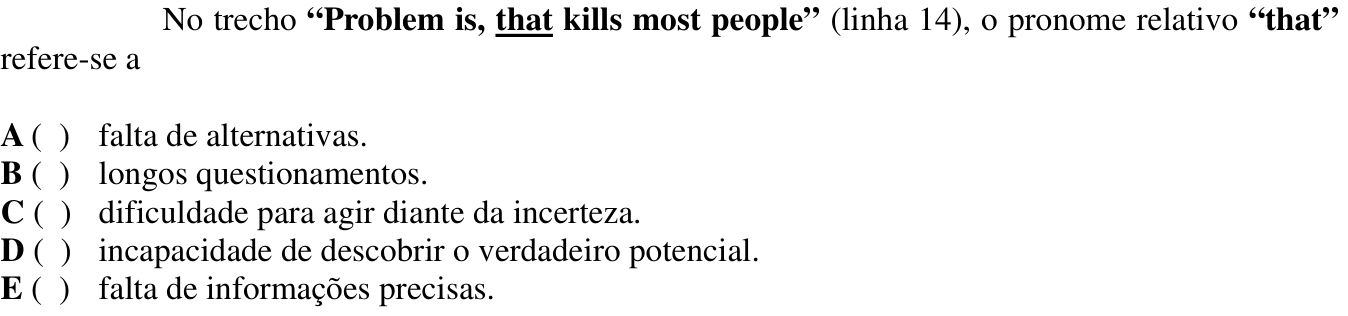
No trecho “Problem is, that kills most people” (linha 14), o pronome relativo “that” refere-se a
- Afalta de alternativas.
- Blongos questionamentos.
- Cdificuldade para agir diante da incerteza.
- Dincapacidade de descobrir o verdadeiro potencial.
- Efalta de informações precisas.
Você já respondeu questões neste aparelho. Crie sua conta grátis para guardar o histórico e refazer as que errou.
Resposta salva no seu histórico.
Reportar erro na questão
Resolução comentada
O "that" de "Problem is, that kills most people" retoma a ideia da frase imediatamente anterior: "When you find the strength to act in the face of uncertainty, you till the soil of genius." Ou seja, o que "mata" a maioria das pessoas é o ato de agir diante da incerteza.
O parágrafo seguinte confirma a leitura: "It leads to unease, anxiety, fear and doubt on a level that snuffs out most genuinely meaningful... endeavors". Esse "It" é o mesmo referente, e o que gera desconforto, ansiedade, medo e dúvida é ter de agir sem certeza. Esse peso emocional faz a maioria desistir antes de realizar algo.
O autor fala da dificuldade de agir em meio à incerteza, e não de falta de alternativas, de informações ou de potencial. Por isso, o referente é a dificuldade de agir diante da incerteza.
Alternativa C.
Por que as outras alternativas estão erradas
- A"There is no alternative" aparece antes, mas só afirma que é preciso agir; não é o que "mata" as pessoas.
- B"Live in the question" é parte da recomendação do autor, não o problema que desanima as pessoas.
- DO texto diz que o potencial emerge ao agir; não fala de incapacidade de descobri-lo como causa do problema.
- EA informação perfeita é citada como algo que não cai do céu; o problema é agir sem ela, não a falta dela.
Assunto: Referência pronominal e pronomes.
Reportar erro na resolução
Ver como caiu na prova
Fonte: ITA 2013 · Inglês. Prova oficial ↗