PRÁTICA COM QUESTÕES OFICIAIS
Questão 17 (Inglês) do ITA 2013
Texto-base das questões 14 a 20 · Inglês
As questões de 14 a 20 referem-se ao texto a seguir:
Reboot the SchoolSALMAN KHAN’S YOUTUBE LESSONS HAVE ALREADY MADE HIM A GEEK CELEBRITY.
NOW HE WANTS TO REINVENT HOMEWORK, BANISH CLASSROOM LECTURES—AND MAYBE SAVE EDUCATION.
By Kayla Webley
Fifth-graders at Eastside College Preparatory School in East Palo Alto, Calif., sit at their desks with netbooks. They're in the middle of a math lesson, listening as a teacher explains how to convert percentages to decimals. "If we get rid of the percent sign, we just have to move the decimal sign two places to the left," the instructor says. Pens scribble across notebooks.
Eleven thousand miles away in Accra, Ghana, students at the African School for Excellence are studying logarithms. Their teacher is the same one firing off math tips in California–both groups of kids are learning by watching online videos. While the screen shows a march of equations and diagrams, the students never actually see the face of the lecturer. There's just a voice, deep, patient and unrehearsed—think NPR host crossed with Mister Rogers. His inflection rises at times to underscore a point or when he gets really excited. "Math is not just random things to memorize and regurgitate on a test next week," he says. "It's the purest way of describing the universe!"
The voice belongs to Salman Khan, a 35-year-old hedge-fund manager turned YouTube professor to millions around the world. Thanks to his Khan Academy, an online repository of some 3,250 digital lectures, he has become a celebrity to techies, educators and uncounted high schoolers cramming for the AP biology test. His 18-minute discourse on the Krebs cycle and cell metabolism has been viewed more than 675,000 times.
But Khan isn't satisfied with being the most famous teacher ever to appear on a Web browser. He believes he has stumbled onto a solution to some of education's most intractable problems, with his video-driven teaching method at its heart. He wants to fundamentally change the role of teachers in the classroom—and redefine the concept of homework along the way. And he has persuaded Bill Gates, Google's Eric Schmidt and a minor constellation of other tech billionaires to back this quest.
Education reform is notoriously difficult. K-12 schools are debating everything from teacher evaluations to standardized tests, with no consensus in sight. Universities, meanwhile, are confronting massive budget cuts and new kinds of competition—as dramatized by the recent turmoil at the University of Virginia. Its board fired the president amid worries that UVa wasn't keeping up with change and embracing online education fast enough, then rehired her 16 days later after a backlash from students and faculty.
At all levels, there's plenty of skepticism about any tech-centric approach to teaching. An estimated $65.7 billion was spent in the U.S. last year on education technology, according to research firm Gartner. But many educators say there is little concrete proof of its benefits.
Khan is already butting up against veteran teachers nervous about their roles in his brave new classroom. But the biggest obstacle of all may be Khan himself. For all his grassroots fandom and Silicon Valley cred, he's not an educator, and he's never worked with children. Are parents and teachers ready to upend hundreds of years of precedent about how basic subjects are taught on the word of a guy who has spent more time analyzing financial statements than standing before a blackboard?
Fonte: Time, July 9, 2012. Texto adaptado.
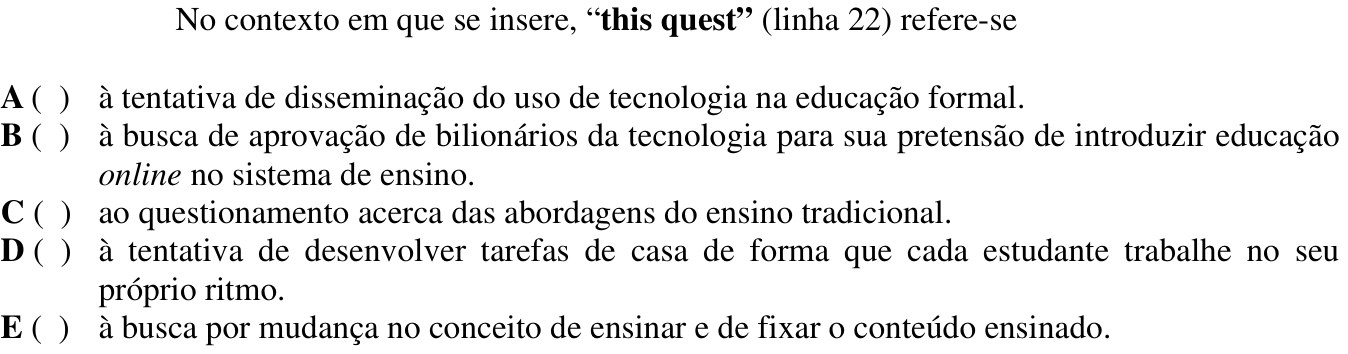
No contexto em que se insere, “this quest” (linha 22) refere-se
- Aà tentativa de disseminação do uso de tecnologia na educação formal.
- Bà busca de aprovação de bilionários da tecnologia para sua pretensão de introduzir educação online no sistema de ensino.
- Cao questionamento acerca das abordagens do ensino tradicional.
- Dà tentativa de desenvolver tarefas de casa de forma que cada estudante trabalhe no seu próprio ritmo.
- Eà busca por mudança no conceito de ensinar e de fixar o conteúdo ensinado.
Você já respondeu questões neste aparelho. Crie sua conta grátis para guardar o histórico e refazer as que errou.
Resposta salva no seu histórico.
Reportar erro na questão
Resolução comentada
A expressão "this quest" é anafórica: retoma o que foi dito logo antes. No parágrafo 4, o texto diz que Khan "wants to fundamentally change the role of teachers in the classroom—and redefine the concept of homework along the way". Só depois vem a frase: "he has persuaded Bill Gates... to back this quest".
Os bilionários, portanto, apoiam a busca (quest) por duas mudanças:
- mudar o papel do professor em sala de aula (deixar de dar aulas expositivas);
- redefinir o conceito de lição de casa, ou seja, a fixação do conteúdo.
A alternativa E resume exatamente isso: mudança no conceito de ensinar (papel do professor) e de fixar o conteúdo (homework).
As demais ficam longe do trecho. A tecnologia na educação (A) é o meio, não o objetivo declarado. Os bilionários já foram convencidos, então a quest não é buscar a aprovação deles (B). O questionamento do ensino tradicional (C) é genérico demais. O ritmo individual do aluno (D) não aparece no trecho e cobre só parte do assunto.
Alternativa E.
Por que as outras alternativas estão erradas
- AConfunde o meio (tecnologia, vídeos) com o objetivo; o texto fala de mudar o papel do professor e a lição de casa.
- BInverte a relação: os bilionários já foram persuadidos a apoiar a busca, que não consiste em obter a aprovação deles.
- CGeneraliza demais; o texto não fala em questionar abordagens tradicionais, e sim em mudar o papel do professor e o conceito de homework.
- DRitmo individual do aluno não é mencionado no trecho e cobre só parte do objetivo.
Assunto: Referência pronominal e pronomes.
Reportar erro na resolução
Ver como caiu na prova
Fonte: ITA 2013 · Inglês. Prova oficial ↗