PRÁTICA COM QUESTÕES OFICIAIS
Questão 9 (Inglês) do ITA 2009
Texto-base das questões 05 a 11 · Inglês
As questões de 5 a 11 referem-se ao seguinte texto:
TEXTILES
Smarter Clothes. Europe wants to own the market for fabrics that can monitor you and your environment
SALLY MCGRANE/PAVIA
1o AT THE EUCENTRE, A RESEARCH SITE cofounded by the Italian Civil Protection Department in Pavia, Italy, a young engineer dons a firefighter’s uniform that has been in testing for six months. The first prototype of the Proetex project, the ordinary looking navy blue jacket and pants contain high-tech fabrics that can keep track of a firefighter’s vital signs, warn him if the fire is too hot up ahead, provide GPS readings of his position and alert the command center if he has passed out. (...)
2o Though the technology was pioneered in the U.S., the Europeans have taken the reins in a bid to revitalize their traditional-textile industry, which has been hammered by Asian competition. “We want to develop state-of-the-art know-how that can’t be found in Asia,” says Andreas Lymberis, a scientific officer with the European Commission who has championed smart textiles. “Our purpose is to create a new market.”
3o Bringing industry partners like Philips and traditional clothing and textile companies together with university researchers from across the E.U. and Switzerland, Commission-funded teams have already produced prototypes with limited commercial availability, such as a tank top that wirelessly monitors cardiac patients and sports clothes that keep track of breathing. Other projects include fabrics that look and feel normal but are embedded with microcomputers, solar panels and energy-harvesting systems, as well as fabrics that measure blood oxygen levels and track biochemicals in sweat and bedsheets that monitor depression.
4o The world market for smart textiles is still small – about $ 550 million in revenue in 2008 – but that could double by 2010, according to Massachusetts-based venture Development Corp. The challenge is to fit applications to the market, says Lutz Walter, R&D manager at Euratex, a group representing the $ 326 billion European clothing-and-textile industry. “In the medical field, there’s high value added. But to be approved as devices takes 10 years,” says Walter. “In other areas, it’s price: How much are consumers going to be willing to pay for a smart jogging shirt or for a baby suit that detects sudden death syndrome?” (...)
5o The development of these technologies is currently taking place largely in the biomedical and safety fields, but Annalisa Bonfiglio, a professor of electrical and electronic engineering at the University of Cagliari who coordinates the Proetex project, thinks sports could be the sector where the most potential lies. “Sportswear is an extremely powerful means for promoting the acceptance of these new technologies by common people,” says Bonfiglio, noting that the technology Proetex develops for rescue workers could easily be used later for sports applications.
6o At the Spaulding Rehabilitation Hospital in Boston, researchers are testing a glove made by Smartex, an Italian smart-materials company, that tracks motor functions in poststroke patients.
7o Smartex founder and University of Pisa biomedical-engineering professor Danilo De Rossi says there is no way of knowing if Europe will maintain its edge. “Right now we are leading in this field,” he says, since Europe tends to be concerned with medicine, social welfare and the elderly, whereas the U.S. tends to focus on military technology. That could change. But in a business driven by technology rather than price, the Europeans would still have a fighting chance.
Time, July 14, 2008 (adapted).
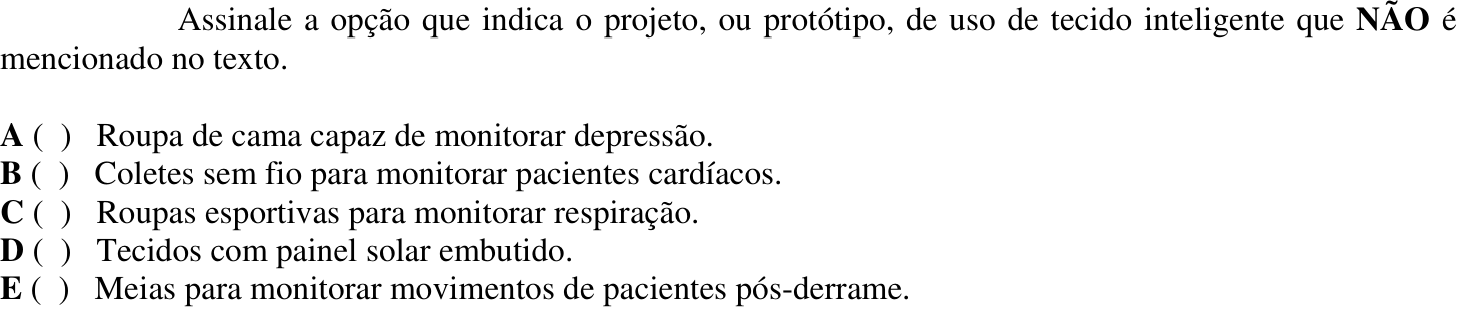
Assinale a opção que indica o projeto, ou protótipo, de uso de tecido inteligente que NÃO é mencionado no texto.
- ARoupa de cama capaz de monitorar depressão.
- BColetes sem fio para monitorar pacientes cardíacos.
- CRoupas esportivas para monitorar respiração.
- DTecidos com painel solar embutido.
- EMeias para monitorar movimentos de pacientes pós-derrame.
Você já respondeu questões neste aparelho. Crie sua conta grátis para guardar o histórico e refazer as que errou.
Resposta salva no seu histórico.
Reportar erro na questão
Resolução comentada
A questão pede o item que não aparece no texto, então é preciso conferir cada alternativa com os trechos.
- (A) Parágrafo 3: "bedsheets that monitor depression" (lençóis que monitoram depressão). Está no texto.
- (B) Parágrafo 3: "a tank top that wirelessly monitors cardiac patients". Uma tank top é uma regata, mas o item fala em "colete sem fio". Peça de vestuário de tronco que monitora cardíacos sem fio: o texto cita, e a ideia é a mesma.
- (C) Parágrafo 3: "sports clothes that keep track of breathing". Está no texto.
- (D) Parágrafo 3: tecidos "embedded with microcomputers, solar panels and energy-harvesting systems". Está no texto.
- (E) Parágrafo 6: o que se testa no hospital de Boston é "a glove" (uma luva) da Smartex, que acompanha funções motoras em pacientes pós-AVC. O texto fala em luva, não em meias.
O monitoramento de funções motoras em pacientes pós-derrame existe, mas a peça é uma luva. A alternativa E troca a peça e por isso não é mencionada.
Alternativa E.
Pegadinha: A alternativa E mantém o assunto real (pacientes pós-derrame), mas troca a luva (glove) por meias.
Por que as outras alternativas estão erradas
- AO parágrafo 3 cita bedsheets que monitoram depressão, então está no texto.
- BO parágrafo 3 cita a tank top que monitora sem fio pacientes cardíacos, então está no texto.
- CO parágrafo 3 cita sports clothes que acompanham a respiração, então está no texto.
- DO parágrafo 3 cita tecidos com solar panels embutidos, então está no texto.
Assunto: Informações explícitas e detalhes.
Reportar erro na resolução
Ver como caiu na prova
Fonte: ITA 2009 · Inglês. Prova oficial ↗