PRÁTICA COM QUESTÕES OFICIAIS
Questão 14 (Inglês) do ITA 2009
Texto-base das questões 13 a 16 · Inglês
As questões de 13 a 16 referem-se ao texto abaixo:
Persuading Leonardo
Although both Ben Shneiderman's Leonardo's Laptop: Human Needs and the New Computing Technologies and B.J. Fogg's Persuasive Technology: Using Computers to Change What We Think and Do are written by academics, the books transcend academia to provide a different view of the Internet's potential. Shneiderman prepares the groundwork for what he calls the "new computing," while Fogg describes how to make that computing persuasive.
The idea behind Leonardo's Laptop is a consideration of what Leonardo da Vinci would demand from a laptop computer and what he would do with it. To Shneiderman, who is founding director of the Human-Computer Interaction Lab at the University of Maryland, the new computing puts users first. Shneiderman begins with a brief history of computing and computer applications, declaring that, "These founders of the old computing overcame technological limitations to build impressive projects and then turned to producing tools for themselves, giving little thought to the needs of other users." Although not a founder, I admit to being of the old computing generation. I programmed in dead languages such as IBM's 1401 Autocoder and 360 Assembler before progressing to Cobol and RPG. I have now learned Visual Basic and C++, and I can report that there is nothing intrinsic to any of these languages that center a programmer's focus on those who use their applications. The new computing is not about languages but, as Shneiderman suggests, about understanding human activities and human relationships.
With Leonardo as both creator and user, his laptop will enable greater creativity and grander goals. This book goads you with ideas for applications in e-learning, e-business, e-healthcare, and e-government. Each area is built around a framework for technology innovation that Shneiderman calls the "four circles of relationships" and the "four stages of activities." (...)
Although the mental picture of Leonardo with a notebook computer excites the imagination, as a literary device, it does not wear well as the book progresses. Nonetheless, Shneiderman achieves the objective of Leonardo's Laptop — creating a foundation for the new computing.
With a new computing application in hand, B.J. Fogg's Persuasive Technology: Using Computers to Change What We Think and Do gives you advice on its implementation. To Fogg, who launched Stanford's Persuasive Technology Lab and who holds seven patents in the area of UI* design, a web site must first be credible to be persuasive. Fogg has coined the term "captology" to describe this branch of the study of computers. From the book's "Introduction:"
Captology focuses on the design, research, and analysis of interactive computing products created for the purpose of changing people's attitudes or behaviors.
It is the computer's ability to provide interactivity that gives its applications an advantage over other forms of media.
Persuasive Technology describes three basic roles that computers play: the computer as a tool, as media, and as a social actor. Further, there are seven types of persuasive tools described by Fogg. Such tools persuade by simplifying, tunneling (guiding), customizing, being there at the right time, removing tedium, rewarding after observation, and reinforcing proper behavior. As media, computers can modify behavior by simulating new endeavors. As a social actor, computers persuade through praise. However, no matter the role, to persuade, the application must be credible.
Perhaps the most interesting parts of Fogg's book are the two chapters that discuss the ways in which computer applications destroy their own credibility and what an application or web site must do to be considered, by its users, trustworthy. According to Fogg, a computing device or application is perceived to be credible only if it is first perceived as believable—trustworthiness based on expertise. In brief, an application is trustworthy if it is thought to be fair and unbiased. It is trustworthy if its author or origin is thought to be skilled and knowledgeable. The crux of the issue is that credibility matters.
Both books are thoroughly documented and both are excellent points of departure for a more detailed inquiry into the available material. If both books are taken to heart, using computers and their applications will become enjoyable and satisfying.
* U.I. - User Inteface
D. Wohlbruck, Dr Dobb’s Journal, January, 2004.
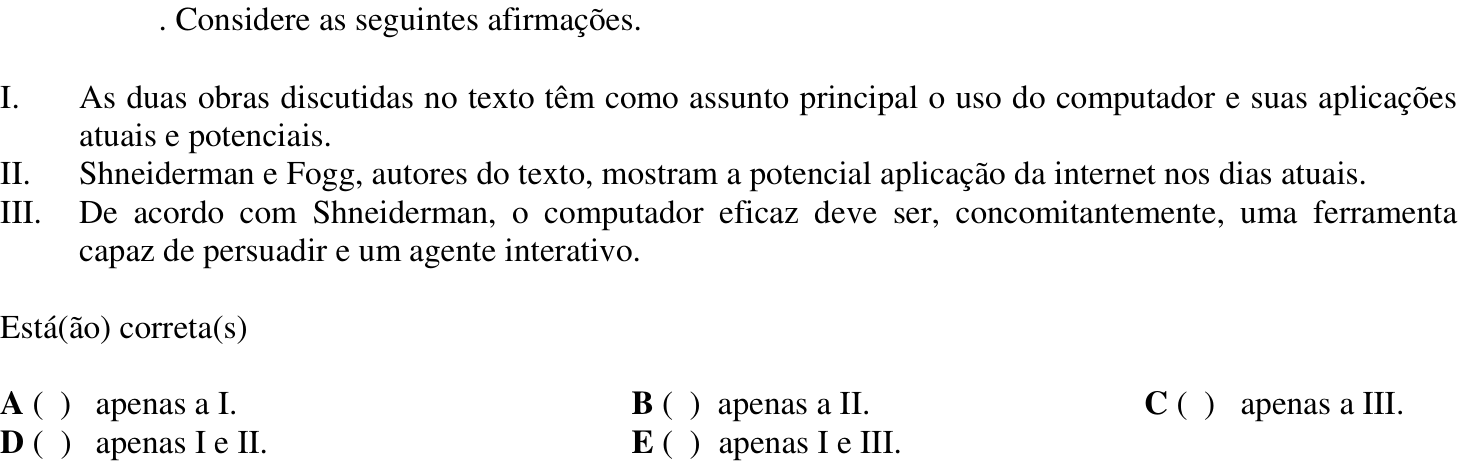
Considere as seguintes afirmações.
I. As duas obras discutidas no texto têm como assunto principal o uso do computador e suas aplicações atuais e potenciais.
II. Shneiderman e Fogg, autores do texto, mostram a potencial aplicação da internet nos dias atuais.
III. De acordo com Shneiderman, o computador eficaz deve ser, concomitantemente, uma ferramenta capaz de persuadir e um agente interativo.
Está(ão) correta(s)
- Aapenas a I.
- Bapenas a II.
- Capenas a III.
- Dapenas I e II.
- Eapenas I e III.
Você já respondeu questões neste aparelho. Crie sua conta grátis para guardar o histórico e refazer as que errou.
Resposta salva no seu histórico.
Reportar erro na questão
Resolução comentada
Vamos testar cada afirmação com o texto.
I. O texto resenha dois livros. Leonardo's Laptop trata do que Leonardo da Vinci faria com um laptop e do "new computing", que põe o usuário em primeiro lugar. Persuasive Technology trata de como computadores e aplicações podem persuadir. Os dois têm como tema o uso do computador e de suas aplicações, atuais e potenciais. Afirmação correta.
II. Shneiderman e Fogg são os autores dos livros resenhados, não do texto. O texto foi escrito por D. Wohlbruck, que é o resenhista. Ele mesmo diz que "both books are written by academics" e que eles oferecem uma visão diferente do potencial da internet. A afirmação atribui a autoria do texto aos dois, e por isso está errada.
III. A persuasão e os papéis do computador (ferramenta, mídia e agente social) pertencem a Fogg, não a Shneiderman. Shneiderman trata do "new computing", centrado no usuário. Atribuir a ele a ideia de computador persuasivo e interativo mistura os dois autores. Afirmação errada.
Só a I está correta.
Alternativa A.
Pegadinha: As afirmações II e III trocam os papéis: a II chama os autores dos livros de autores do texto, e a III atribui a Shneiderman as ideias de Fogg.
Por que as outras alternativas estão erradas
- BA II chama Shneiderman e Fogg de autores do texto, mas eles são os autores dos livros resenhados; o texto é de Wohlbruck.
- CA III atribui a Shneiderman a ideia de computador persuasivo e interativo, que é de Fogg.
- DInclui a II, que erra a autoria do texto.
- EInclui a III, que confunde as ideias de Shneiderman com as de Fogg.
Assunto: Informações explícitas e detalhes.
Reportar erro na resolução
Ver como caiu na prova
Fonte: ITA 2009 · Inglês. Prova oficial ↗