PRÁTICA COM QUESTÕES OFICIAIS
Questão 47 da FUVEST 2022
TEXTO PARA AS QUESTÕES DE 45 A 47
If you take a look at my smartphone, you’ll know that I like to order out. But am I helping the small local businesses? You would think that if you own a restaurant you’d be thrilled to have an outsourced service that would take care of your delivery operations while leveraging their marketing might to expand your businesses’ brand. However, restaurant owners have complained of lack of quality control once their food goes out the door. They don’t like that the delivery people are the face of their product when it gets into the customer’s hand. Some of the delivery services have been accused of listing restaurants on their apps without the owners’ permission, and oftentimes publish menu items and prices that are incorrect or out of date.
But there is another reason why restaurant owners aren’t fond of delivery services. It’s the costs, which, for some, are becoming unsustainable. Even with the increased revenues from the delivery services, the fees wind up killing a restaurant’s margins to the extent that it’s at best marginally profitable. Therefore, some restaurants are pushing harder to drive orders from their own websites and offering special deals for customers that use their in-house delivery people.
The simple fact is that these delivery apps are here to stay. They are enormously popular and have significantly grown. I believe that restaurant owners that resist these apps are hurting their brands by missing out on potential customers. The good news is that the delivery platforms are not as evil as some would portray them. They have some skin in the game. They are competing against other services. They want their listed restaurants to profit. Maybe instead of fighting, the nation’s restaurant industry needs to proactively embrace the delivery service industry and figure out ways to profitably work together.
The Guardian. 02 December, 2020. Adaptado.
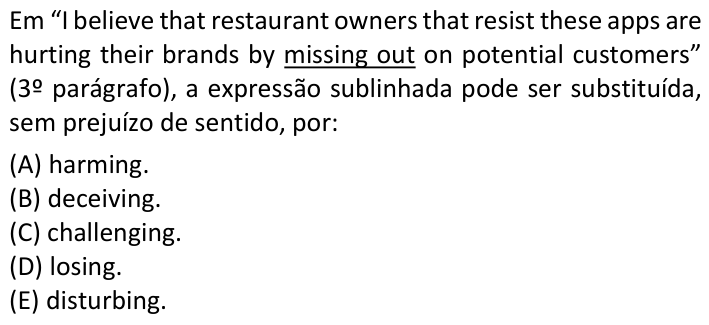
Em “I believe that restaurant owners that resist these apps are hurting their brands by missing out on potential customers” (3o parágrafo), a expressão sublinhada pode ser substituída, sem prejuízo de sentido, por:
- Aharming.
- Bdeceiving.
- Cchallenging.
- Dlosing.
- Edisturbing.
Você já respondeu questões neste aparelho. Crie sua conta grátis para guardar o histórico e refazer as que errou.
Resposta salva no seu histórico.
Reportar erro na questão
Resolução comentada
O phrasal verb miss out on significa perder uma oportunidade ou vantagem por não aproveitá-la. No trecho, os donos de restaurante que resistem aos aplicativos deixam de ganhar clientes em potencial, ou seja, perdem essa chance.
Portanto, a ideia é de perda de oportunidade:
- hurting their brands by missing out on potential customers = prejudicam suas marcas ao perder clientes em potencial.
- O verbo que traduz essa ideia, mantendo a estrutura "by + verbo-ing + complemento", é losing (perdendo).
Conferindo as demais:
- harming e disturbing significam prejudicar e perturbar, e o texto já usa hurting para o dano à marca.
- deceiving é enganar.
- challenging é desafiar.
Nenhuma delas expressa perder clientes.
Alternativa D.
Por que as outras alternativas estão erradas
- Aharming significa prejudicar, sinônimo de hurting, e não de perder uma oportunidade.
- Bdeceiving significa enganar, sentido que não aparece no trecho.
- Cchallenging significa desafiar, sem relação com deixar de ganhar clientes.
- Edisturbing significa perturbar, o que não tem relação com perder clientes.
Assunto: Expressões idiomáticas e phrasal verbs.
Reportar erro na resolução
Ver como caiu na prova