Questão 30 da FUVEST 2020
TEXTO PARA AS QUESTÕES 29 E 30
Scientists have long touted DNA’s potential as an ideal storage medium; it’s dense, easy to replicate, and stable over millennia. But in order to replace existing silicon-chip or magnetic-tape storage technologies, DNA will have to get a lot cheaper to predictably read, write, and package.
That’s where scientists like Hyunjun Park come in. He and the other cofounders of Catalog, an MIT DNA-storage spinoff emerging out of stealth on Tuesday, are building a machine that will write a terabyte of data a day, using 500 trillion molecules of DNA.
If successful, DNA storage could be the answer to a uniquely 21st-century problem: information overload. Five years ago humans had produced 4.4 zettabytes of data; that's set to explode to 160 zettabytes (each year!) by 2025. Current infrastructure can handle only a fraction of the coming data deluge, which is expected to consume all the world's microchip-grade silicon by 2040.
“Today’s technology is already close to the physical limits of scaling,” says Victor Zhirnov, chief scientist of the Semiconductor Research Corporation. “DNA has an information-storage density several orders of magnitude higher than any other known storage technology.”
How dense exactly? Imagine formatting every movie ever made into DNA; it would be smaller than the size of a sugar cube. And it would last for 10,000 years.
Wired, June, 2018. Disponível em https://www.wired.com/. Adaptado.
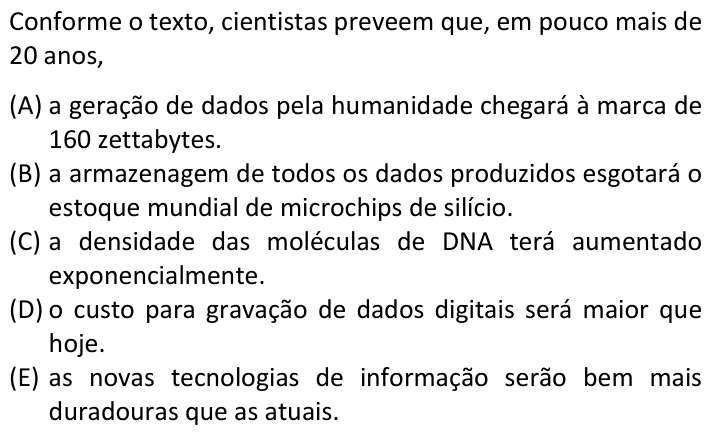
Conforme o texto, cientistas preveem que, em pouco mais de 20 anos,
- Aa geração de dados pela humanidade chegará à marca de 160 zettabytes.
- Ba armazenagem de todos os dados produzidos esgotará o estoque mundial de microchips de silício.
- Ca densidade das moléculas de DNA terá aumentado exponencialmente.
- Do custo para gravação de dados digitais será maior que hoje.
- Eas novas tecnologias de informação serão bem mais duradouras que as atuais.
Reportar erro na questão
Ver como caiu na prova