Questão 23 da FUVEST 2017
TEXTO PARA AS QUESTÕES 22 E 23
A study carried out by Lauren Sherman of the University of California and her colleagues investigated how use of the “like” button in social media affects the brains of teenagers lying in body scanners.
Thirty-two teens who had Instagram accounts were asked to lie down in a functional magnetic resonance imaging (fMRI) scanner. This let Dr. Sherman monitor their brain activity while they were perusing both their own Instagram photos and photos that they were told had been added by other teenagers in the experiment. In reality, Dr. Sherman had collected all the other photos, which included neutral images of food and friends as well as many depicting risky behaviours like drinking, smoking and drug use, from other peoples’ Instagram accounts. The researchers told participants they were viewing photographs that 50 other teenagers had already seen and endorsed with a “like” in the laboratory.
The participants were more likely themselves to “like” photos already depicted as having been “liked” a lot than they were photos depicted with fewer previous “likes”. When she looked at the fMRI results, Dr. Sherman found that activity in the nucleus accumbens, a hub of reward circuitry in the brain, increased with the number of “likes” that a photo had.
The Economist, June 13, 2016. Adaptado.
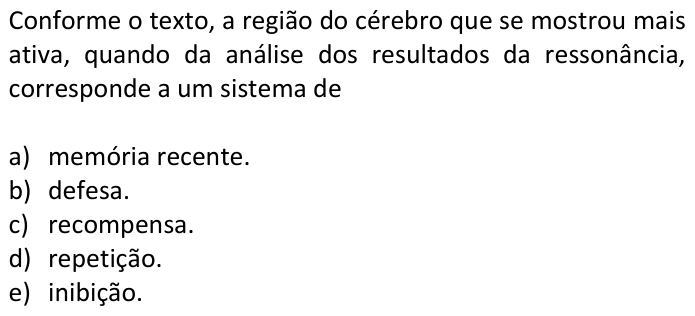
Conforme o texto, a região do cérebro que se mostrou mais ativa, quando da análise dos resultados da ressonância, corresponde a um sistema de
- Amemória recente.
- Bdefesa.
- Crecompensa.
- Drepetição.
- Einibição.
Reportar erro na questão
Resolução comentada
A pergunta pede a função da região cerebral que se mostrou mais ativa na ressonância. O trecho decisivo está no último parágrafo: "activity in the nucleus accumbens, a hub of reward circuitry in the brain, increased with the number of 'likes' that a photo had".
Traduzindo: a atividade no núcleo accumbens, "um centro do circuito de recompensa do cérebro", aumentou conforme crescia o número de curtidas da foto.
- A região que ficou mais ativa é o nucleus accumbens.
- O texto a descreve como hub of reward circuitry, ou seja, o centro do circuito de recompensa.
- "Reward" significa "recompensa".
- Logo, a região pertence a um sistema de recompensa.
O texto não cita memória, defesa, repetição nem inibição ao falar do núcleo accumbens. Esses termos são só distratores.
Alternativa C.
Por que as outras alternativas estão erradas
- AO texto não relaciona o núcleo accumbens à memória recente.
- BNão há menção a um sistema de defesa; o circuito descrito é o de recompensa.
- DA repetição não é função citada; o texto fala em curtir fotos já muito curtidas, não em um sistema de repetição.
- EInibição não aparece no texto; a atividade aumenta com as curtidas, associada à recompensa.
Assuntos: interpretação de texto em inglês, vocabulário (reward).
Reportar erro na resolução
Ver como caiu na prova