PRÁTICA COM QUESTÕES OFICIAIS
Questão 88 da FUVEST 2006
Texto-base das questões 85 a 88

Australians are not known for their love of boat people. They famously turned away a small group of Afghan refugees at the height of the war and rather amusingly, ran a scare campaign featuring crocodiles and sharks to deter would-be immigrants. But if global warming continues at its current rate, neighbouring Pacific islands could be lost to floods and Australia will be facing a new kind of intruder: climate refugees.
Although the Red Cross produced a report four years ago estimating that 58 per cent of refugees are caused by environmental factors, no one has made any attempt to tackle the issue. Oxford University’s Norman Myers recently claimed that there could be an estimated 150 million environmental refugees within the next 50 years, and half of these could land on Australia’s doorstep. But the UN refuses to grant them refugee status, and aid groups and environmentalists squabble over whose responsibility they are.
DAZED & CONFUSED July 2005
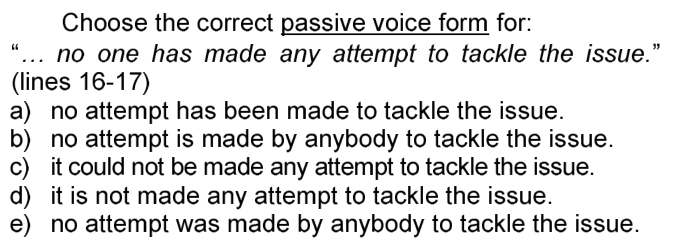
Choose the correct passive voice form for:
“... no one has made any attempt to tackle the issue.”
(lines 16-17)
- Ano attempt has been made to tackle the issue.
- Bno attempt is made by anybody to tackle the issue.
- Cit could not be made any attempt to tackle the issue.
- Dit is not made any attempt to tackle the issue.
- Eno attempt was made by anybody to tackle the issue.
Você já respondeu questões neste aparelho. Crie sua conta grátis para guardar o histórico e refazer as que errou.
Resposta salva no seu histórico.
Reportar erro na questão
Resolução comentada
Para passar uma frase para a voz passiva, o objeto da ativa vira sujeito, o verbo vai para o particípio com o auxiliar be e o tempo verbal original é mantido.
- Ativa: no one (sujeito) + has made (present perfect) + any attempt (objeto).
- O objeto attempt vira sujeito. Como a frase já é negativa por causa de no one, o sujeito da passiva leva a negação: no attempt.
- O present perfect (has made) vira has been made, ou seja, has/have + been + particípio.
- O agente no one pode ser omitido, pois é indefinido.
Resultado: No attempt has been made to tackle the issue.
As demais opções mudam o tempo verbal. A B usa presente simples e a E usa passado simples, enquanto o original está no present perfect. As opções C e D usam construção impessoal com it, que não existe em inglês nesse caso, porque attempt é o objeto e deve ser o sujeito da passiva.
Alternativa A.
Por que as outras alternativas estão erradas
- BTroca o present perfect por presente simples (is made), mudando o tempo verbal.
- CUsa it como sujeito, o que é agramatical, e muda o tempo para could.
- DUsa it is not made any attempt, construção agramatical, e muda o tempo para presente simples.
- EUsa passado simples (was made) em vez de present perfect.
Assunto: Tempos verbais e verbos modais.
Reportar erro na resolução
Ver como caiu na prova