PRÁTICA COM QUESTÕES OFICIAIS
Questão 33 (1º exame) da FUVEST 2002
Texto para as questões de 30 a 35 · V
The role of women in Spanish society has changed fast since the country became a democracy after General Franco died in 1975. He had swept away liberal reforms introduced in the 1930s, when Spain was a republic. For women specifically, these included a benevolent divorce law and certain property rights. In the 1930s many women played a big part on the left, often fighting side by side with men in the pro-Republic militias during the 1936-39 civil war. But after it the new regime, for the most part applauded by the church, put them back in the home as wives and mothers, with divorce forbidden and working outside frowned on.
Change began in the 1960s when Spain opened up to tourists. Faced with competition from sexually liberated north Europeans, Spanish women “declared war on them, on men and on their elders”, in the words of Lucia Graves, author of “A Woman Unknown”, which recounts her life as an Englishwoman married to a Spaniard at the time. That aggressive self-assertion continues.
Not wholly successfully. At universities, women students now outnumber men. A typical couple has one or two children these days, a far cry from the days when families of eight or ten were common. But Spanish women still face the problems of their sisters in northern Europe. Their progress at work is often blocked, their pay often lower than men’s.
The Economist August 11th 2001
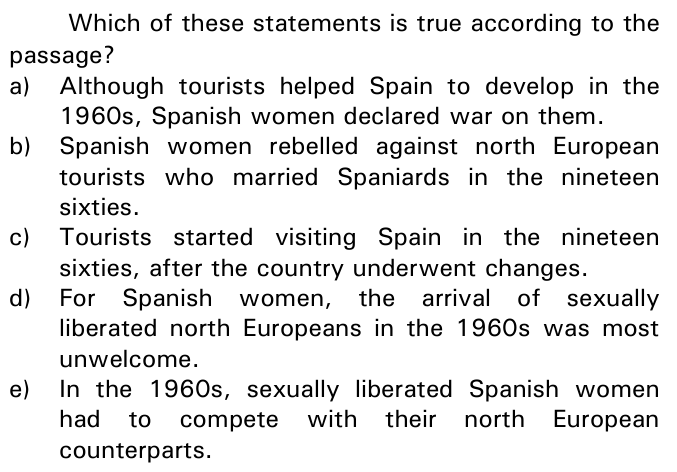
Which of these statements is true according to the passage?
- AAlthough tourists helped Spain to develop in the 1960s, Spanish women declared war on them.
- BSpanish women rebelled against north European tourists who married Spaniards in the nineteen sixties.
- CTourists started visiting Spain in the nineteen sixties, after the country underwent changes.
- DFor Spanish women, the arrival of sexually liberated north Europeans in the 1960s was most unwelcome.
- EIn the 1960s, sexually liberated Spanish women had to compete with their north European counterparts.
Você já respondeu questões neste aparelho. Crie sua conta grátis para guardar o histórico e refazer as que errou.
Resposta salva no seu histórico.
Reportar erro na questão
Resolução comentada
A informação decisiva está no segundo parágrafo: “Faced with competition from sexually liberated north Europeans, Spanish women ‘declared war on them’”. Isso significa: “Diante da concorrência de norte-europeias sexualmente liberadas, as espanholas ‘declararam guerra a elas’”.
A expressão “declararam guerra” é figurada: indica rivalidade e reação à presença dessas turistas, não um conflito militar. Portanto, a chegada das norte-europeias foi recebida com hostilidade pelas espanholas. É essa reação que a alternativa D apresenta ao dizer que a chegada delas foi muito indesejada.
Observe por que as demais não correspondem ao texto: A acrescenta uma contribuição dos turistas para o desenvolvimento espanhol que não é mencionada; B atribui às turistas casamentos que o texto não relata — quem se casou com um espanhol foi Lucia Graves; C inverte a relação apresentada, pois a abertura ao turismo marcou o início das mudanças; E transfere às espanholas a característica de sexualmente liberadas, atribuída às norte-europeias.
Alternativa D.
Pegadinha: A alternativa E mantém a ideia de competição, mas troca o grupo caracterizado como sexualmente liberado.
Por que as outras alternativas estão erradas
- AAcrescenta que os turistas ajudaram no desenvolvimento da Espanha, informação não apresentada no texto.
- BAfirma que as turistas se casaram com espanhóis, confundindo-as com a autora Lucia Graves.
- CColoca as mudanças antes do turismo, enquanto o texto associa o início delas à abertura aos turistas.
- EAtribui às espanholas a liberdade sexual que o texto destaca nas norte-europeias.
Assunto: Informações explícitas e detalhes.
Reportar erro na resolução
Ver como caiu na prova
Fonte: FUVEST 2002 · 1º exame. Prova oficial ↗