PRÁTICA COM QUESTÕES OFICIAIS
Questão 31 (1º exame) da FUVEST 2002
Texto para as questões de 30 a 35 · V
The role of women in Spanish society has changed fast since the country became a democracy after General Franco died in 1975. He had swept away liberal reforms introduced in the 1930s, when Spain was a republic. For women specifically, these included a benevolent divorce law and certain property rights. In the 1930s many women played a big part on the left, often fighting side by side with men in the pro-Republic militias during the 1936-39 civil war. But after it the new regime, for the most part applauded by the church, put them back in the home as wives and mothers, with divorce forbidden and working outside frowned on.
Change began in the 1960s when Spain opened up to tourists. Faced with competition from sexually liberated north Europeans, Spanish women “declared war on them, on men and on their elders”, in the words of Lucia Graves, author of “A Woman Unknown”, which recounts her life as an Englishwoman married to a Spaniard at the time. That aggressive self-assertion continues.
Not wholly successfully. At universities, women students now outnumber men. A typical couple has one or two children these days, a far cry from the days when families of eight or ten were common. But Spanish women still face the problems of their sisters in northern Europe. Their progress at work is often blocked, their pay often lower than men’s.
The Economist August 11th 2001
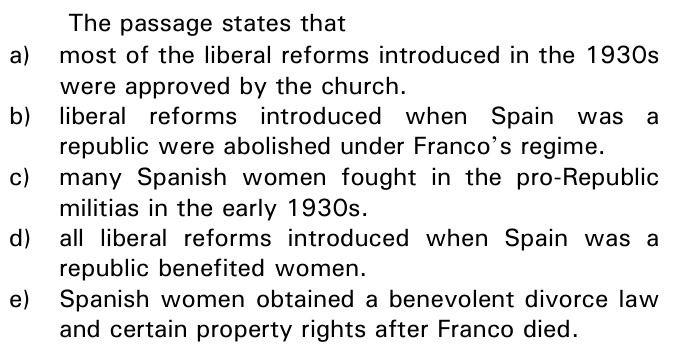
The passage states that
- Amost of the liberal reforms introduced in the 1930s were approved by the church.
- Bliberal reforms introduced when Spain was a republic were abolished under Franco’s regime.
- Cmany Spanish women fought in the pro-Republic militias in the early 1930s.
- Dall liberal reforms introduced when Spain was a republic benefited women.
- ESpanish women obtained a benevolent divorce law and certain property rights after Franco died.
Você já respondeu questões neste aparelho. Crie sua conta grátis para guardar o histórico e refazer as que errou.
Resposta salva no seu histórico.
Reportar erro na questão
Resolução comentada
O texto diz, logo no início, que Franco "had swept away liberal reforms introduced in the 1930s, when Spain was a republic". Swept away significa "varrer, eliminar", ou seja, as reformas liberais da República foram abolidas no regime de Franco. Isso corresponde exatamente à alternativa B.
Confira as outras:
- A: o texto diz que a Igreja aplaudiu o novo regime (applauded by the church), não as reformas.
- C: as mulheres lutaram nas milícias durante a guerra civil, de 1936 a 1939, e não no início dos anos 1930.
- D: o texto cita divórcio e direitos de propriedade como reformas específicas para mulheres (for women specifically), e não afirma que todas as reformas as beneficiaram.
- E: esses direitos foram concedidos nos anos 1930, e Franco os eliminou. Depois de sua morte, o texto fala apenas de mudanças rápidas no papel da mulher.
Alternativa B.
Por que as outras alternativas estão erradas
- AA Igreja aplaudiu o regime de Franco, não as reformas liberais; o texto não diz que ela as aprovou.
- CA luta nas milícias ocorreu na guerra civil (1936-39), não no início dos anos 1930.
- DGeneraliza: o texto só cita divórcio e propriedade como reformas voltadas às mulheres, não que todas as reformas as beneficiaram.
- EEsses direitos vieram nos anos 1930, na República; Franco os aboliu, e não foram obtidos depois de sua morte.
Assunto: Informações explícitas e detalhes.
Reportar erro na resolução
Ver como caiu na prova
Fonte: FUVEST 2002 · 1º exame. Prova oficial ↗