PRÁTICA COM QUESTÕES OFICIAIS
Questão 38 (1º exame) da FUVEST 2001
Texto para as questões de 37 a 40 · V
MICHAEL D. COE’S Breaking the Maya Code. Revised paperback edition. First published 1992. Thames & Hudson, New York, 1999 ($18.95).
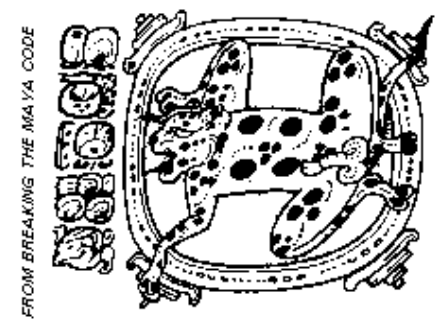
The decipherment of the Maya script was, Coe states, "one of the most exciting intellectual adventures of our age, on a par with the exploration of space and the discovery of the genetic code." He presents the story eloquently and in detail, with many illustrations of the mysterious Maya inscriptions and the people who tried to decipher them. Most of the credit, he says, goes to the late Yuri V. Knorosov of the Russian Institute of Ethnography, but many others participated. They did not always agree, and some of them went up blind alleys. Coe— emeritus professor of anthropology at Yale University—vividly describes the battles, missteps and successes. What is now established, he writes, is that “the Maya writing system is a mix of logograms and syllabic signs; with the latter, they could and often did write words purely phonetically.”
SCIENTIFIC AMERICAN
APRIL 2000
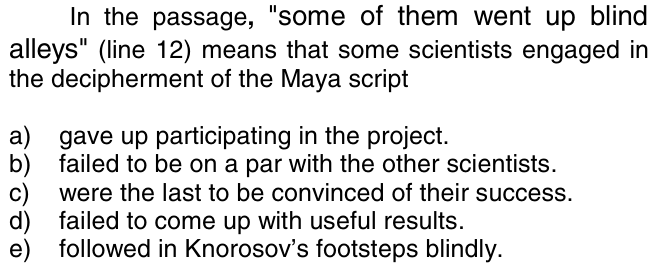
In the passage, "some of them went up blind alleys" (line 12) means that some scientists engaged in the decipherment of the Maya script
- Agave up participating in the project.
- Bfailed to be on a par with the other scientists.
- Cwere the last to be convinced of their success.
- Dfailed to come up with useful results.
- Efollowed in Knorosov’s footsteps blindly.
Você já respondeu questões neste aparelho. Crie sua conta grátis para guardar o histórico e refazer as que errou.
Resposta salva no seu histórico.
Reportar erro na questão
Resolução comentada
"Blind alley" é um beco sem saída. Em sentido figurado, designa um caminho, uma linha de investigação ou uma ideia que não leva a lugar nenhum.
Veja o contexto: "They did not always agree, and some of them went up blind alleys". Os estudiosos discordavam entre si, e alguns seguiram pistas que não deram resultado. Logo, "went up blind alleys" quer dizer que esses pesquisadores seguiram caminhos improdutivos.
Testando as alternativas:
- Desistir do projeto não é o que a frase diz: eles continuaram trabalhando, só que em direções erradas.
- "On a par with" aparece em outro trecho do texto, com o sentido de "no mesmo nível de". Não tem relação com a expressão em questão.
- Nada no texto fala em ser o último a se convencer.
- "Failed to come up with useful results" (não chegar a resultados úteis) traduz bem a ideia de beco sem saída.
- O texto diz que Knorosov recebeu a maior parte do crédito, mas não que os outros o seguiam às cegas. "Blind" aqui faz parte da expressão fixa, não significa "seguir cegamente".
Alternativa D.
Pegadinha: A alternativa E engana ao interpretar "blind" literalmente, como "seguir cegamente", e ao usar o nome de Knorosov, citado no texto.
Por que as outras alternativas estão erradas
- AConfunde seguir um caminho errado com abandonar o projeto; o texto não fala em desistência.
- BReaproveita "on a par with", que vem de outra frase do texto, e nada tem a ver com "blind alleys".
- CInventa uma ideia de convencimento tardio que o texto não menciona.
- EToma "blind" ao pé da letra (seguir às cegas) e inventa uma ligação com Knorosov.
Assunto: Expressões idiomáticas e phrasal verbs.
Reportar erro na resolução
Ver como caiu na prova
Fonte: FUVEST 2001 · 1º exame. Prova oficial ↗