PRÁTICA COM QUESTÕES OFICIAIS
Questão 35 (1º exame) da FUVEST 2000
Texto-base das questões 34 a 40 · V
The Sydney Olympics – billed as the Green Games – open in exactly 64 weeks, on 15 September 2000. In bidding for the Games, the Sydney delegates promised that theirs would be the most environmentally-friendly Games ever. But there are growing doubts that Sydney will deliver on its promises, even though Australia holds a commanding lead in the race to develop key environmentally-friendly technologies.
The biggest single obstacle to the Green Games is the site itself. The land around Homebush Bay, in western Sydney, was an industrial graveyard previously used by chemical giants such as ICI and Union Carbide – infamous for the Bhopal plant leak on 3 December 1984 that poisoned thousands in India.
Their legacy was toxic waste in unmarked sites. The bodies associated with the bid knew about this, and saw the Games as a way to clean up the mess and create a new community. Thus Sydney’s bid document featured a glorious artist’s impression of a ceremonial entrance on the waterfront, where, beneath fluttering bunting, Olympic athletes and grandees arrive from downtown on eco-friendly water taxis. It was, says Murray Hogarth, environmental correspondent of the Sydney Morning Herald, “an absolutely key facet of the bid”.
THE FRIDAY REVIEW
The Independent 25 June 1999

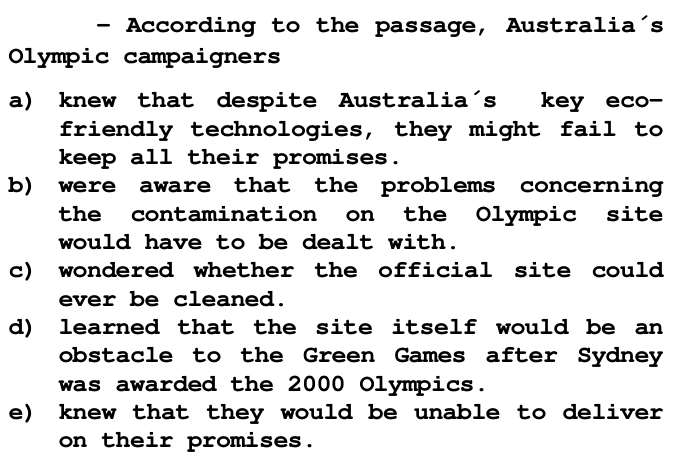
– According to the passage, Australia´s Olympic campaigners
- Aknew that despite Australia´s key eco-friendly technologies, they might fail to keep all their promises.
- Bwere aware that the problems concerning the contamination on the Olympic site would have to be dealt with.
- Cwondered whether the official site could ever be cleaned.
- Dlearned that the site itself would be an obstacle to the Green Games after Sydney was awarded the 2000 Olympics.
- Eknew that they would be unable to deliver on their promises.
Você já respondeu questões neste aparelho. Crie sua conta grátis para guardar o histórico e refazer as que errou.
Resposta salva no seu histórico.
Reportar erro na questão
Resolução comentada
O texto diz que o terreno de Homebush Bay era um "industrial graveyard" com resíduos tóxicos em locais sem sinalização. Em seguida afirma: "The bodies associated with the bid knew about this, and saw the Games as a way to clean up the mess and create a new community". Ou seja, os organizadores da candidatura sabiam da contaminação e viam os Jogos como oportunidade de limpar a área.
Agora compare com as alternativas:
- Procure o que o texto diz sobre o que os organizadores sabiam: eles conheciam o lixo tóxico e planejavam limpá-lo. Isso significa que o problema da contaminação teria de ser tratado.
- A alternativa B diz exatamente isso: eles estavam cientes de que a contaminação precisaria ser resolvida.
- As demais atribuem aos organizadores dúvidas, previsão de fracasso ou descoberta posterior, e nada disso aparece no texto. As "dúvidas" mencionadas no primeiro parágrafo ("growing doubts") são de observadores externos, não dos organizadores.
Alternativa B.
Por que as outras alternativas estão erradas
- AO texto não diz que os organizadores previam falhar; as dúvidas crescentes são de observadores, e a Austrália lidera em tecnologias verdes.
- COs organizadores viam os Jogos como forma de limpar a área, sem duvidar de que isso fosse possível.
- DEles já conheciam o problema do terreno antes da candidatura, e não só depois da escolha de Sydney.
- EAfirma que sabiam que não cumpririam as promessas, o que o texto não sustenta.
Assunto: Informações explícitas e detalhes.
Reportar erro na resolução
Ver como caiu na prova
Fonte: FUVEST 2000 · 1º exame. Prova oficial ↗