PRÁTICA COM QUESTÕES OFICIAIS
Questão 26 da FMABC 2025
Leia o texto e examine o gráfico para responder às questões de 21 a 28. · Conhecimentos Gerais
Obesity is one of the world’s most serious public-health crises. It increases the risks of developing diabetes, heart disease, stroke and some cancers. Since 1990 global rates have doubled among adults and quadrupled among children. More than 1 billion people, including 7% of girls and 9% of boys, were classified as obese in the year 2022. In 2019 it led to around 5 million deaths. Obesity is no longer just a rich-world problem. Childhood rates are highest on the islands of the Pacific and the Caribbean, and rising fastest in developing countries such as Cambodia and Lesotho.
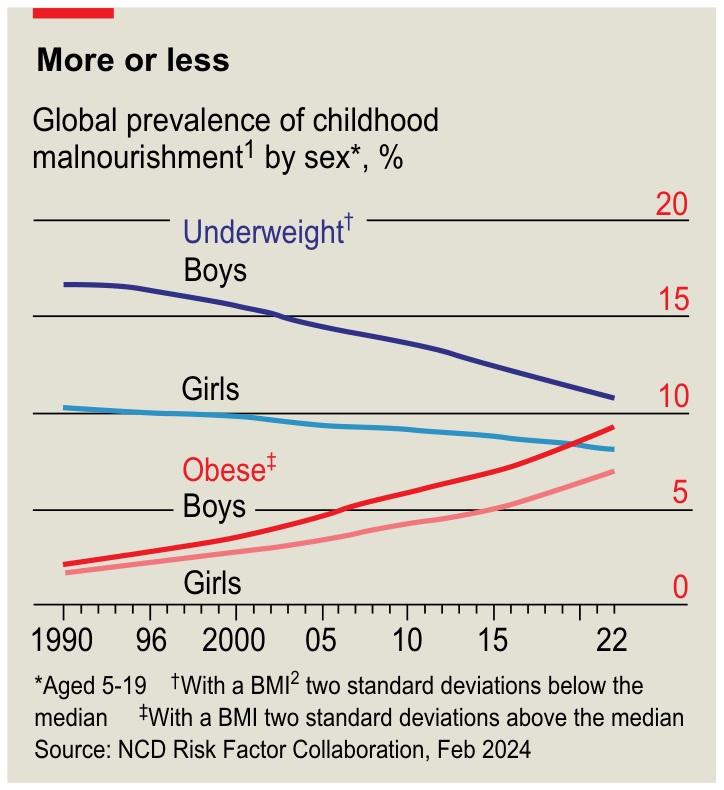
Most of the economic costs of obesity are faced by individuals, who take more time off work or miss more days of school, and are more likely to be low-paid or unemployed. Obese children are more often targets for bullies, too. But the burden on the state is also perceptible. In 2023, the Institute for Fiscal Studies estimated the annual costs of overweight and obese adults through health-care expenses, formal social care and inactivity at work as 1% of Britain’s GDP (Gross Domestic Product).
Although telling adults what to eat and when to move can be seen as interfering, governments should try to prevent children becoming obese and encourage their weight-loss efforts. Early interventions could obtain benefits later: children with obesity are five times more likely to be obese as adults than thinner ones. The trouble is, nobody knows how best to go about it. No country has ever managed to reduce obesity; the more successful ones have merely restrained it. The problem is too complex to be solved by simple public-health measures or obesity drugs alone. The hunt is on to find evidence for interventions that work together, and quickly.
(www.economist.com, 08.08.2024. Adaptado.)
1 malnourishment: nutrição deficiente devido à ingestão inadequada ou desbalanceada de nutrientes.
2 BMI: body mass index (índice de massa corporal).
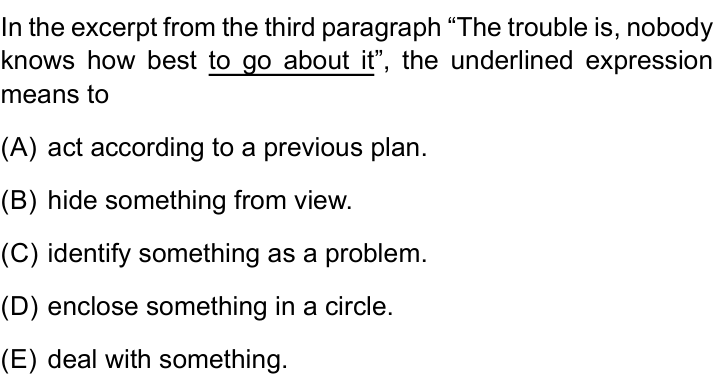
In the excerpt from the third paragraph “The trouble is, nobody knows how best to go about it”, the underlined expression means to
- Aact according to a previous plan.
- Bhide something from view.
- Cidentify something as a problem.
- Denclose something in a circle.
- Edeal with something.
Você já respondeu questões neste aparelho. Crie sua conta grátis para guardar o histórico e refazer as que errou.
Resposta salva no seu histórico.
Reportar erro na questão
Resolução comentada
A expressão "to go about something" é um phrasal verb que significa "abordar algo, começar a lidar com algo, tomar providências para resolver". Em "how to go about it", o sentido é "como lidar com isso" ou "como abordar isso".
Para achar o referente de "it", olhe a frase anterior do texto: o governo deve tentar evitar que crianças se tornem obesas e incentivar a perda de peso delas. Então a frase quer dizer: "O problema é que ninguém sabe a melhor maneira de lidar com isso (a obesidade infantil)".
O contexto confirma essa leitura. A frase seguinte diz que nenhum país conseguiu reduzir a obesidade, e que a busca é por intervenções eficazes. Ou seja, o autor fala de como enfrentar o problema, e não de seguir um plano prévio, esconder algo ou cercar algo.
A alternativa que traduz esse sentido é "deal with something" (lidar com algo, enfrentar).
Alternativa E.
Por que as outras alternativas estão erradas
- AO texto diz que ninguém sabe como agir, e não que se deva seguir um plano prévio; "go about" não significa isso.
- BConfunde com a ideia de ocultar algo; nada no contexto fala de esconder a obesidade.
- CIdentificar algo como problema já está dito ("The trouble is"); a questão é como enfrentá-lo.
- DInterpreta "about" literalmente como "em volta de" (cercar), ignorando o sentido do phrasal verb.
Assunto: Expressões idiomáticas e phrasal verbs.
Reportar erro na resolução
Ver como caiu na prova
Fonte: FMABC 2025 · Conhecimentos Gerais. Prova oficial ↗