PRÁTICA COM QUESTÕES OFICIAIS
Questão 11 do Einstein 2027
Read the text to answer questions from 11 to 14. · Prova I
1 If artificial intelligence (AI) systems shape decisions that affect people’s lives, they should do so impartially. But guaranteeing the fairness1 of AI systems is far more complex than it might sound. What counts as fair in one domain may be inappropriate in another. In criminal justice, fairness may prioritise avoiding disproportionate harm to particular communities. In education, it may focus on equal opportunities for all. In finance, it often involves balancing access to credit with risk analysis.
A deeper issue lies in the data itself. AI systems learn from historical datasets that reflect past decisions, institutional practices, and social inequalities. When a model is trained to replicate observed outcomes, it may reproduce existing injustices under the appearance of objectivity.
Let’s take a look at hiring decisions. If a company historically promoted fewer women into senior roles, an AI system trained to predict “successful” job candidates may learn patterns that favour characteristics more common among men, even if gender is not explicitly included as an input. A fundamental question is whether AI systems mirror the world as it was, or attempt to correct for known injustices.
The idea of fairness is also complicated by how it is assessed. Many assessments examine a single protected attribute, such as gender or race, in isolation. While common, this approach can obscure how discrimination operates in practice. An automated hiring system might appear fair when comparing men and women overall, and fair when comparing ethnic groups overall, yet it might also consistently disadvantage older women from minority backgrounds.
5 Societies change, demographics shift and language evolves. A system that performs satisfactorily today may produce unfair outcomes tomorrow. In particular, recent advances in large language models (LLMs)2 add further complexity. Unlike traditional systems that make specific predictions, LLMs generate language based on vast collections of historical text which, inevitably, contain imbalances. Fairness is therefore an ongoing responsibility requiring monitoring, and a willingness to revise or withdraw systems when harms emerge. Together, challenges suggest that fairness in AI is not a purely technical problem but a moving target shaped by social values and historical context.
(Michael Mayowa Farayola. https://theconversation.com,
12.05.2026. Adapted.)
1 fairness: the quality of being impartial and free from bias.
2 large language models (LLMs): AI systems trained on massive amounts of text data to understand and generate human-like language.
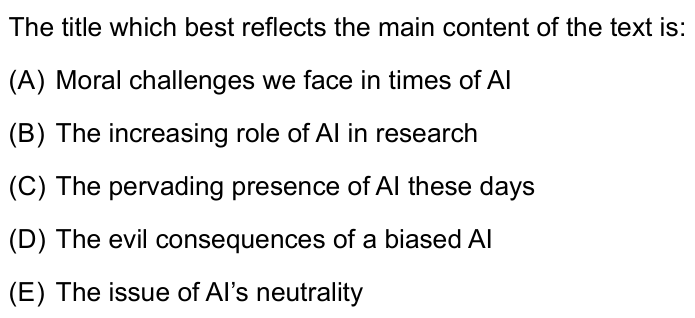
The title which best reflects the main content of the text is:
- AMoral challenges we face in times of AI
- BThe increasing role of AI in research
- CThe pervading presence of AI these days
- DThe evil consequences of a biased AI
- EThe issue of AI’s neutrality
Você já respondeu questões neste aparelho. Crie sua conta grátis para guardar o histórico e refazer as que errou.
Resposta salva no seu histórico.
Reportar erro na questão
Resolução comentada
Para achar o melhor título, veja o tema que organiza todos os parágrafos, e não só um detalhe.
O texto começa dizendo que sistemas de IA que afetam a vida das pessoas deveriam decidir de forma imparcial (impartially), mas que garantir isso é complexo. Depois mostra por que:
- a noção de justiça muda conforme a área (justiça criminal, educação, finanças);
- os dados históricos carregam desigualdades, e o modelo pode reproduzi-las "sob a aparência de objetividade";
- o exemplo da contratação mostra viés mesmo sem o gênero como variável;
- a avaliação de um único atributo pode esconder discriminação combinada (mulheres mais velhas de minorias);
- a sociedade muda, e os LLMs herdam desequilíbrios dos textos históricos.
A conclusão é que a justiça (fairness) em IA não é um problema puramente técnico, e sim "um alvo móvel". Ou seja, o texto todo trata de a IA ser ou não imparcial/neutra, e de como isso é difícil de garantir.
Assim, o título que resume o conteúdo é "The issue of AI's neutrality" (a questão da neutralidade da IA).
Alternativa E.
Por que as outras alternativas estão erradas
- AFala de desafios morais de forma ampla; o texto foca na imparcialidade dos sistemas, não em dilemas morais gerais da era da IA.
- BO papel crescente da IA na pesquisa não é abordado em nenhum trecho.
- CA onipresença da IA hoje não é o assunto; ela é só o pano de fundo.
- DO tom é analítico e não trata de consequências 'malignas'; o foco é a dificuldade de garantir justiça, não só os danos do viés.
Assunto: Ideia central e finalidade do texto.
Reportar erro na resolução
Ver como caiu na prova
Fonte: Einstein 2027 · Prova I. Prova oficial ↗