PRÁTICA COM QUESTÕES OFICIAIS
Questão 14 do Einstein 2026
Read the text to answer questions from 11 to 14. · Prova I
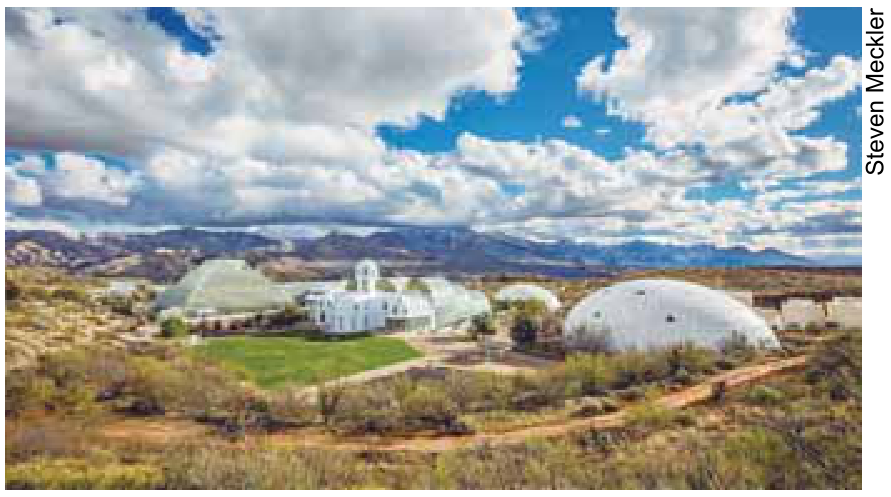
In the middle of the vast Arizona desert, in the United States, there’s a structure that seems taken straight out of the pages of science fiction. Inside a massive complex of glass pyramids and towers, spread across 1.2 hectares, stands a tropical rainforest topped by a 7.6-meter-high waterfall, a savannah and a fog desert. It’s seemingly a little capsule of Earth, which is why the structure is called Biosphere 2 — named after our own planet, Biosphere 1.
The scenery forms the perfect background for the futuristic experiment that once took place here. In the early 1990s, eight people locked themselves inside, sealed off from the outside world for two years, to explore the challenges of living in a self-contained system — a prerequisite for building colonies in outer space. They fed themselves from the crops they grew, they recycled their own wastewater and they cared for the plants that produced their oxygen.
In terms of sustaining human life, the experiment did not go well. Oxygen levels fell significantly, making the inhabitants sick, while carbon dioxide (\ce{CO2}) levels increased. Countless animals died, including the pollinators the plants needed to reproduce. And although the “biospherians” did survive on their homegrown food, they lost weight to the point where they became a case study for calorie restriction. When supplementary oxygen needed to be brought in, commentators blamed the project as a failure, calling it a “new-age silliness masquerading as science”. In recent years, however, many experts have come to see the Biosphere 2 experiment in a new light, with valuable lessons about ecology, atmospheric science and importantly, the irreplaceability of our own planet.
(Katarina Zimmer. www.bbc.com, 05.07.2025. Adapted.)
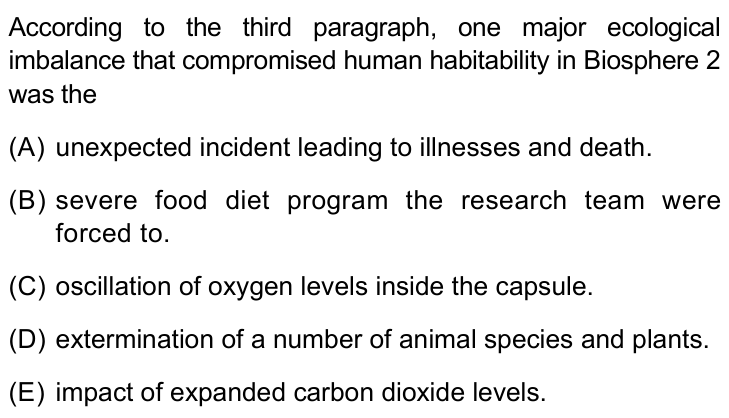
According to the third paragraph, one major ecological imbalance that compromised human habitability in Biosphere 2 was the
- Aunexpected incident leading to illnesses and death.
- Bsevere food diet program the research team were forced to.
- Coscillation of oxygen levels inside the capsule.
- Dextermination of a number of animal species and plants.
- Eimpact of expanded carbon dioxide levels.
Você já respondeu questões neste aparelho. Crie sua conta grátis para guardar o histórico e refazer as que errou.
Resposta salva no seu histórico.
Reportar erro na questão
Resolução comentada
O enunciado pede um desequilíbrio ecológico que comprometeu a habitabilidade humana, segundo o terceiro parágrafo. Isso quer dizer uma alteração no ambiente, não uma consequência para as pessoas.
O parágrafo cita estes fatos:
- O oxigênio caiu bastante ("Oxygen levels fell significantly"), o que adoeceu os moradores, e o \ce{CO2} aumentou ("levels increased").
- Muitos animais morreram, inclusive os polinizadores de que as plantas precisavam.
- Os "biospherians" perderam peso por causa da alimentação restrita.
- Foi preciso levar oxigênio extra.
Agora, as alternativas:
- (A) fala de doenças e mortes. Mas as doenças foram efeito da queda de oxigênio, e quem morreu foram animais, não pessoas. Não é um desequilíbrio ecológico.
- (B) fala da dieta, que foi consequência da escassez de alimento, não um desequilíbrio ambiental.
- (C) diz "oscilação" do oxigênio. O texto diz que o nível caiu, sem oscilar para cima e para baixo.
- (D) fala em "extermínio" de espécies de animais e plantas. O texto diz que muitos animais morreram, mas não que plantas foram exterminadas.
- (E) fala do impacto do aumento de \ce{CO2}. O texto diz que o \ce{CO2} aumentou, e isso é um desequilíbrio atmosférico que compromete a vida humana.
As alternativas A, B, C e D distorcem o texto, e só a E o respeita.
Alternativa E.
Pegadinha: A alternativa C engana ao trocar a queda do oxigênio por "oscilação", e a D ao incluir plantas entre os extermínios.
Por que as outras alternativas estão erradas
- ADoenças são efeito da queda de oxigênio, e as mortes citadas são de animais, não de pessoas; não é desequilíbrio ecológico em si.
- BA dieta restrita foi consequência da produção de alimento, não um desequilíbrio ambiental.
- CO oxigênio caiu de forma significativa; o texto não fala em oscilação.
- DO texto cita a morte de muitos animais, mas não diz que plantas foram exterminadas.
Assunto: Informações explícitas e detalhes.
Reportar erro na resolução
Ver como caiu na prova
Fonte: Einstein 2026 · Prova I. Prova oficial ↗