PRÁTICA COM QUESTÕES OFICIAIS
Questão 13 do Einstein 2024
Read the text to answer questions from 11 to 15. · Prova I
Rescuers spotted debris from the tourist submarine Titan on the ocean floor near the wreck of the Titanic on June 22, 2023, indicating that the vessel suffered a catastrophic failure and the five people aboard were killed. Below, Purdue University professor Nina Mahmoudian talks about vehicles for deep ocean research.
Nina Mahmoudian: When we talk about water studies, we’re talking about vast areas. And covering vast areas requires tools that can work for extended periods of time, sometimes months. Having people aboard underwater vehicles, especially for such long periods, is expensive and dangerous.
One of the tools researchers use is remotely operated vehicles, or ROVs. Basically, there is a cable between the vehicle and operator that allows the operator to command and move the vehicle, and the vehicle can transmit data in real time. ROVs can reach deep ocean — up to a depth of 6,000 meters. It’s also better able to provide the mobility necessary for observing the sea bed and gathering data.
Autonomous underwater vehicles provide another opportunity for underwater exploration. They are usually not tied to a ship. They are typically programmed ahead of time to do a specific mission. And while they are underwater they usually don’t have constant communication. At some interval, they surface, relay the data that they have gathered, change the battery or recharge and receive renewed instructions before again submerging.
Crewed1 submersibles will be exciting for the public and those involved. However, they will be much more expensive compared with uncrewed explorations because of the required size of the platforms and the need for life-support systems. So, uncrewed vehicles provide better opportunities for exploration at less cost and risk in operating in inhospitable locations. Using remotely operated and autonomous underwater vehicles gives operators the opportunity to perform tasks that are unsafe for humans, like observing under ice and detecting underwater mines.
(https://theconversation.com, 23.06.2023. Adapted.)
1crewed: carrying or operated by a person or people on board.
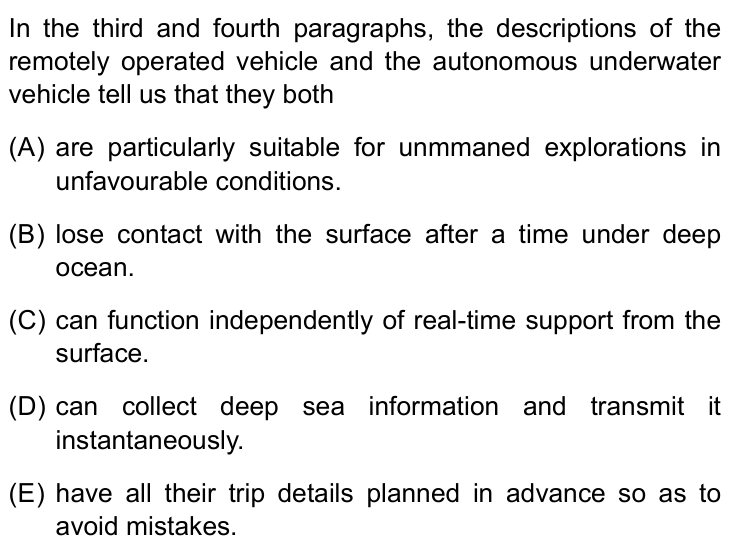
In the third and fourth paragraphs, the descriptions of the remotely operated vehicle and the autonomous underwater vehicle tell us that they both
- Aare particularly suitable for unmmaned explorations in unfavourable conditions.
- Blose contact with the surface after a time under deep ocean.
- Ccan function independently of real-time support from the surface.
- Dcan collect deep sea information and transmit it instantaneously.
- Ehave all their trip details planned in advance so as to avoid mistakes.
Você já respondeu questões neste aparelho. Crie sua conta grátis para guardar o histórico e refazer as que errou.
Resposta salva no seu histórico.
Reportar erro na questão
Resolução comentada
A questão pede o que o ROV (terceiro parágrafo) e o AUV (quarto parágrafo) têm em comum.
-
ROV: há um cabo entre o veículo e o operador, que comanda o veículo e recebe dados em tempo real. Ele é controlado à distância e não é programado antes.
-
AUV: em geral não fica preso a um navio, é programado antecipadamente para uma missão e não mantém comunicação constante enquanto está submerso. Só de tempos em tempos sobe à superfície para enviar dados e receber novas instruções.
-
Ponto em comum: nenhum dos dois leva pessoas a bordo (são uncrewed). O quarto parágrafo conclui que veículos não tripulados dão mais oportunidades de exploração com menos custo e risco em locais inóspitos (inhospitable locations). O último trecho diz ainda que operadores podem usar ROVs e AUVs para tarefas inseguras para humanos, como observar sob o gelo e detectar minas submarinas. Isso corresponde a unmanned explorations in unfavourable conditions.
-
Verificação das demais: perda de contato, independência do suporte da superfície, transmissão instantânea e planejamento prévio valem, no máximo, para só um dos dois tipos.
Portanto, a característica compartilhada é ser adequado a explorações não tripuladas em condições desfavoráveis.
Alternativa A.
Pegadinha: As alternativas B, C, D e E descrevem corretamente um dos veículos, mas não ambos; o enunciado exige o que é comum aos dois.
Por que as outras alternativas estão erradas
- BSó o AUV fica sem comunicação constante; o ROV é ligado por cabo e mantém contato contínuo.
- CVale para o AUV, mas o ROV depende do operador pelo cabo, em tempo real.
- DSó o ROV transmite dados em tempo real; o AUV os repassa apenas quando sobe à superfície.
- ESó o AUV é programado antes da missão; o ROV é comandado pelo operador.
Assunto: Inferência e ponto de vista do autor.
Reportar erro na resolução
Ver como caiu na prova
Fonte: Einstein 2024 · Prova I. Prova oficial ↗