PRÁTICA COM QUESTÕES OFICIAIS
Questão 12 do Einstein 2023
Read the text to answer questions from 11 to 14. · Prova I
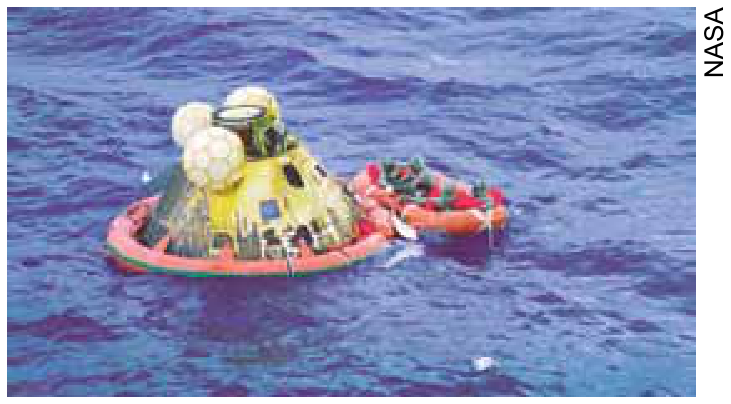
In the late 1960s, following the Apollo 11 Moon landings, the three astronauts were waiting to be picked up inside their capsule floating in the Pacific Ocean — and they were hot and uncomfortable. NASA officials decided to make things more pleasant for their three national heroes. The downside? There was a small possibility of unleashing deadly alien microbes on Earth.
When humanity first made plans to send probes and people into space in the mid-20th Century, the issue of contamination came up. Firstly, there was the fear of “forward” contamination — the possibility that Earth-based life might accidentally hitch a ride into the cosmos. Spacecraft needed to be sterilised and carefully packaged before launch. If microbes silently moved onboard, it would confuse any attempts to detect alien life. And if there were extra-terrestrial organisms out there, we might end up inadvertently killing them with Earth-based bacteria or viruses. These concerns matter just as much today as they did back in the Space Race era.
A second concern was “back” contamination. This was the idea that astronauts, rockets or probes returning to Earth might bring back life that could prove catastrophic, either by consuming all our oxygen or outcompeting Earth organisms. What if the astronauts brought back something dangerous? At the time, the probability was not considered high, but still, the scenario had to be explored. “Maybe it’s sure to 99% that Apollo 11 will not bring back lunar organisms,” said one influential scientist at the time, “but even that 1% of uncertainty is too large to be complacent about.”
NASA put several quarantine measures in place — in some cases, a little reluctantly. Concerned officials from the US Public Health Service argued for stricter measures than initially planned, pointing out that they had the power to refuse border entry to contaminated astronauts. NASA then agreed to install a costly quarantine facility on the ship that would pick up the men from their splashdown in the Pacific Ocean. It was also agreed that the lunar explorers would then spend three weeks in isolation before they could hug their families or shake the hand of the president.
(Richard Fisher. www.bbc.com, 18.02.2021. Adapted.)
The first paragraph mentions
- Athe discomfort experienced by the Apollo 11 astronauts inside their capsule.
- Bthe very moment in which the lunar explorers are rescued from the sea.
- Cthe successful completion of a spacecraft mission to the Moon.
- Dthings that can possibly go wrong in long spaceship trips.
- ENASA officials’ pride in showing the world their three national heroes.
Você já respondeu questões neste aparelho. Crie sua conta grátis para guardar o histórico e refazer as que errou.
Resposta salva no seu histórico.
Reportar erro na questão
Resolução comentada
A questão pede o que o primeiro parágrafo menciona, então só vale o que está escrito nele. Vamos conferir os pontos do parágrafo:
- "the three astronauts were waiting to be picked up inside their capsule floating in the Pacific Ocean — and they were hot and uncomfortable": os astronautas ainda esperavam ser resgatados, com calor e desconforto.
- "NASA officials decided to make things more pleasant": a NASA quis melhorar a situação deles.
- "The downside? There was a small possibility of unleashing deadly alien microbes on Earth": o risco era pequeno, mas existia.
O parágrafo cita o desconforto dos astronautas dentro da cápsula, o que corresponde à alternativa A.
As demais não se sustentam. O resgate ainda não tinha acontecido: eles esperavam ser recolhidos. O texto fala de pouso na Lua apenas como contexto e não de conclusão bem-sucedida da missão como tema. Não há menção a problemas em viagens espaciais longas. E a NASA queria tornar os astronautas mais confortáveis, sem falar em orgulho nem em exibi-los ao mundo.
Alternativa A.
Por que as outras alternativas estão erradas
- BOs astronautas estavam esperando o resgate; o momento do resgate não é descrito.
- CO parágrafo apenas situa o pouso lunar como contexto, sem tratar da conclusão bem-sucedida da missão.
- DNão se fala de problemas em viagens longas, e sim de um risco de contaminação por micróbios.
- EO texto diz que a NASA queria deixá-los confortáveis, não que sentisse orgulho em mostrá-los ao mundo.
Assunto: Informações explícitas e detalhes.
Reportar erro na resolução
Ver como caiu na prova
Fonte: Einstein 2023 · Prova I. Prova oficial ↗