PRÁTICA COM QUESTÕES OFICIAIS
Questão 73 (CFS 1) da EEAR 2027
Read the text and answer questions 73, 74, 75 and 76. · CFS 1
Be Persistent In Whatever You Do
In life, all of us feel the urge to do something great and achieve success. These urges are different for each one of us. For some, it might be working hard to get a business up and running, and for someone like me, it can be something as simple as writing 3 articles per week. So, we all feel like we are good at something and therefore we should focus completely on it to achieve success. What happens next? We start, we fail, we get tired and in the end, we give up on these tasks completely.
I _____experienced this a lot in my life and I believe that almost everyone has, at some point in their life. But, the question is: why do we give up on things? Is it because we are not as good at them as we thought or is it because we failed in trying to achieve them? The answer to the problem of giving up on things is: we lack persistence.
Adapted. https://medium.com/writers-blokke/be-persistent-in-whatever-you-do-5a48a485ace2
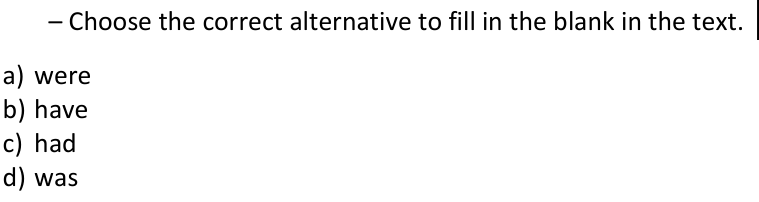
– Choose the correct alternative to fill in the blank in the text.
- Awere
- Bhave
- Chad
- Dwas
Reportar erro na questão
Resolução comentada
A lacuna vem entre o sujeito "I" e o verbo "experienced": "I _____ experienced this a lot in my life". Isso indica a formação de um tempo composto com o particípio passado.
O trecho seguinte dá a pista decisiva: "and I believe that almost everyone has, at some point in their life". O "has" ali retoma a mesma estrutura, "has experienced". Isso mostra que o tempo verbal é o Present Perfect (have/has + particípio), usado para experiências ao longo da vida, sem marcar quando aconteceram, e ligadas ao presente.
Passo a passo:
- Sujeito: "I".
- Verbo principal: "experienced" (particípio passado).
- Para o Present Perfect com "I", o auxiliar é "have": "I have experienced".
As outras opções não funcionam. "Were" e "was" são formas de "to be" e exigiriam outra estrutura ("I was experienced" não tem esse sentido). "Had" formaria o Past Perfect ("I had experienced"), que pede um ponto de referência no passado, e o texto não traz nenhum. Além disso, ele não combinaria com o "has" no presente da oração seguinte.
Alternativa B.
Por que as outras alternativas estão erradas
- A"were" é passado de "to be" (plural/you) e não forma tempo composto com "experienced" nem concorda com "I".
- C"had experienced" é Past Perfect, que exige um ponto de referência no passado ausente no texto e destoa do "has" seguinte.
- D"was" é passado de "to be"; "I was experienced" não expressa o sentido de ter vivido isso.
Assunto: Tempos verbais e verbos modais.
Reportar erro na resolução
Ver como caiu na prova
Fonte: EEAR 2027 · CFS 1. Prova oficial ↗