PRÁTICA COM QUESTÕES OFICIAIS
Questão 74 (CFS 1) da EEAR 2026
Read the text and answer questions 73, 74, 75, 76 and 77. · CFS 1
Why man’s best friend is still a four-legged substitute parent?
Márcio Paulo Barbosa Pena Mascarenhas
Man’s best friends is actually a substitute parent, fulfilling deep emotional needs that humans fail to meet, according to a leading dog expert. People bond with dogs as much as babies do with mothers, and reap unconditional love, security and protection from the relationship.
Dr. Valerie O’ Farrel - a psychologist - says that dogs can also compensate for an unhappy childhood. People perceive in their pets qualities lacking in their parents. According to him, most dogs perform remarkably well as “emotional sponges”, soaking up owners’ hang-ups. “Dogs obviously cannot understand the nature of their owners’ predicaments in the way that a sympathetic human listener can. Because the dog does not get upset or angry or go away, the owner can imagine he understands”, states the doctor.
As well as protection, concern for our well-being and unconditional love, we often assign to dogs a fourth parental function: providing a safe and welcoming base to come home to. Some canines take this duty very seriously, Dr. O’ Farrel reveals. She describes the experience of a 37-year-old beauty therapist with her faithfull mongrel. “He would follow me to the station each morning to see me off”. I would watch him from the carriage and see him about to turn and go home. Invariably, he would be there to meet me when I got off the train at night. And what’s more surprising - we lived about a mile and a half from the station.
Grade 1, Student’s book, Belo Horizonte,14th edition.
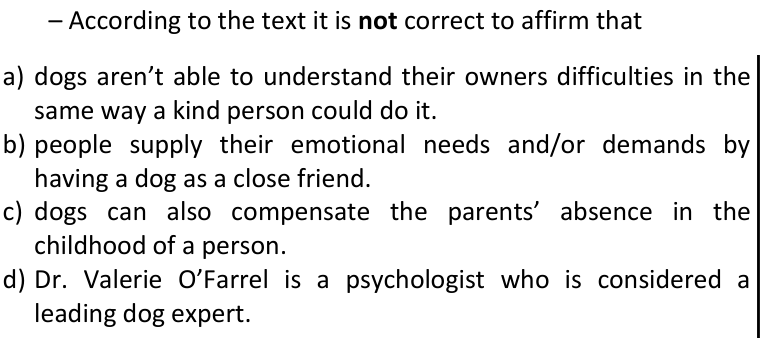
– According to the text it is not correct to affirm that
- Adogs aren’t able to understand their owners difficulties in the same way a kind person could do it.
- Bpeople supply their emotional needs and/or demands by having a dog as a close friend.
- Cdogs can also compensate the parents’ absence in the childhood of a person.
- DDr. Valerie O’Farrel is a psychologist who is considered a leading dog expert.
Reportar erro na questão
Resolução comentada
A questão pede a alternativa que não está de acordo com o texto. Por isso, confira cada uma contra o que o texto diz.
-
(A) O texto afirma que os cães "cannot understand the nature of their owners' predicaments in the way that a sympathetic human listener can". Isso é o que a alternativa diz: o cão não entende as dificuldades do dono como uma pessoa gentil entenderia. Está de acordo com o texto.
-
(B) O texto diz que o cão cumpre "deep emotional needs" e oferece amor incondicional, segurança e proteção. Logo, as pessoas suprem suas necessidades emocionais por meio do cão. Está de acordo com o texto.
-
(C) O texto diz que os cães podem compensar "an unhappy childhood", porque as pessoas veem neles qualidades que faltaram aos pais. Isso é compensar a infância infeliz e as qualidades ausentes nos pais, não a ausência física dos pais. A alternativa troca "infância infeliz" por "ausência dos pais", o que o texto não afirma. É a alternativa que não pode ser afirmada.
-
(D) O texto cita Dr. Valerie O'Farrel como "a psychologist" e a apresenta como "a leading dog expert" no primeiro parágrafo. Está de acordo com o texto.
A única alternativa que não pode ser afirmada com base no texto é a C.
Alternativa C.
Pegadinha: A alternativa C engana ao trocar "infância infeliz" por "ausência dos pais"; o texto fala em qualidades que faltaram aos pais, não em ausência deles.
Por que as outras alternativas estão erradas
- AReproduz fielmente a passagem em que o cão não entende as dificuldades do dono como um ouvinte humano compreensivo.
- BO texto diz que o cão supre necessidades emocionais profundas que os humanos não suprem.
- DO texto apresenta Dr. O'Farrel como psicóloga e como especialista de destaque em cães.
Assunto: Informações explícitas e detalhes.
Reportar erro na resolução
Ver como caiu na prova
Fonte: EEAR 2026 · CFS 1. Prova oficial ↗