PRÁTICA COM QUESTÕES OFICIAIS
Questão 86 (CFS 2) da EEAR 2025
Read the text and answer questions 83, 84, 85, 86 and 87. · CFS 2
How long will you live?
Everyone wants to live a long and healthy life. Today, many scientists are trying to find the habits that help people live longer. In 1970, some scientists talked to 7,000 people in the United States and got information about ___________ habits. Then they checked to see how long the people lived.
The scientists learned that the people with the longest lives did seven things. (1) They ate breakfast every day. (2) They didn’t eat snacks between meals. (3) They weren’t too heavy or too thin. (4) They exercised regularly. (5) They slept seven to eight hours every night - not more, and not less. (6) They didn’t smoke. (7) They didn’t drink more than two alcoholic drinks per day.
These were the habits that made a big difference. People who did all of these things lived 12 years longer than people who did only one to three of the things.
Scientists say that you should change your habits slowly. Make one small change every week. You need about 21 days to make a new habit.
Adapted. World English 1B. 2010. Heinle Cengage Learning.
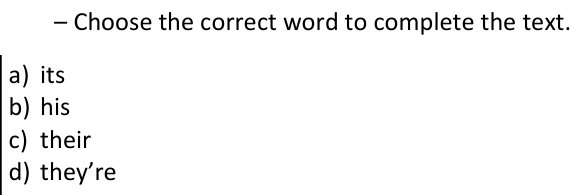
— Choose the correct word to complete the text.
- Aits
- Bhis
- Ctheir
- Dthey’re
Reportar erro na questão
Resolução comentada
A lacuna vem antes de "habits", então precisa de um pronome possessivo (adjetivo possessivo), que acompanha o substantivo e indica a quem pertencem os hábitos.
Veja o contexto da frase:
- "Some scientists talked to 7,000 people" → o sujeito de quem se fala é 7,000 people, um grupo, ou seja, plural.
- Os hábitos pertencem a essas pessoas, então o possessivo deve concordar com um plural: "their habits" (os hábitos deles).
- O restante do texto confirma: "Then they checked to see how long the people lived", sempre referindo-se ao grupo.
Checando as opções:
- its é usado para coisas ou animais no singular, e não para pessoas.
- his é masculino singular, e não combina com 7.000 pessoas.
- their é o possessivo plural, o que cabe aqui.
- they're é a contração de they are ("eles são"), que não pode vir antes de um substantivo: "they are habits" não faz sentido na frase.
A frase completa fica: "...got information about their habits."
Alternativa C.
Pegadinha: A alternativa D engana por ser homófona de "their" (pronúncia igual), mas "they're" é a contração de "they are".
Por que as outras alternativas estão erradas
- A"its" é possessivo de coisa ou animal no singular, não serve para um grupo de pessoas.
- B"his" é masculino singular e não concorda com "7,000 people".
- D"they're" significa "they are", um verbo, e não um possessivo; não cabe antes de "habits".
Assunto: Referência pronominal e pronomes.
Reportar erro na resolução
Ver como caiu na prova
Fonte: EEAR 2025 · CFS 2. Prova oficial ↗