PRÁTICA COM QUESTÕES OFICIAIS
Questão 80 (CFS 1) da EEAR 2025
Read the text and answer questions 80, 81 and 82. · CFS 1
Many studies about language learning ask the question: What makes a good language learner?
There are some things that good language learners do and some things they don’t do. Here are some of the most useful suggestions from studies:
- Don’t be afraid of making mistakes. People often get things wrong. Good language learners notice their mistakes and learn from them.
- Do group activities. People use language to communicate with other people. A good language learner always looks for opportunities to talk with other students.
- Make notes during every class. Notes help you to remember new language. Look at your notes when you do your homework.
- Use a dictionary. Good language learners often use dictionaries to check the meaning of words they don’t know. They also make their own vocabulary lists.
- Think in the language you’re learning outside the classroom. When you’re shopping or walking down the street, remember useful words and phrases. Sometimes, when you’re at home, say new words to practise your pronunciation.
- Do extra practice. Test and improve your language, reading and listening skills with self-study material. You can find a lot of this online.
- Imagine yourself speaking in the language. Many good language learners can see and hear themselves speaking in the language. This helps their motivation.
- Enjoy the process. Good language learners have fun with the language. Watch a TV series or film, listen to songs, play video games or read a book. It’s never too late to become a good language learner.
https://learnenglish.britishcouncil.org/skills/reading/a2-reading/study-skills-tips
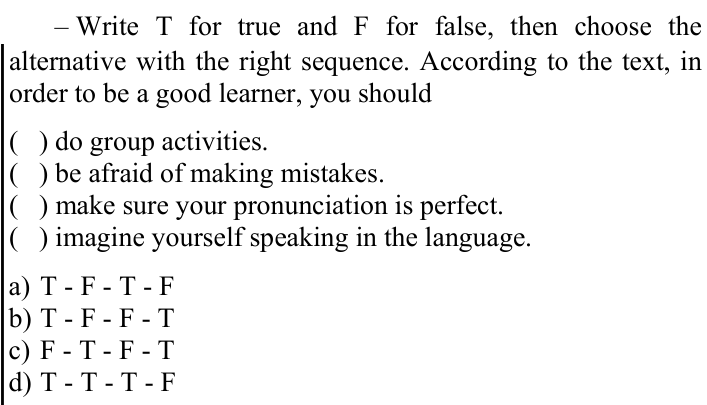
– Write T for true and F for false, then choose the alternative with the right sequence. According to the text, in order to be a good learner, you should
( ) do group activities.
( ) be afraid of making mistakes.
( ) make sure your pronunciation is perfect.
( ) imagine yourself speaking in the language.
- AT - F - T - F
- BT - F - F - T
- CF - T - F - T
- DT - T - T - F
Reportar erro na questão
Resolução comentada
Basta conferir cada afirmação com as dicas do texto.
-
Do group activities (fazer atividades em grupo): o texto traz exatamente essa dica, "Do group activities", e explica que o bom aprendiz procura oportunidades de conversar com outros alunos. Verdadeira (T).
-
Be afraid of making mistakes (ter medo de errar): o texto diz o contrário, "Don't be afraid of making mistakes". Falsa (F).
-
Make sure your pronunciation is perfect (garantir que a pronúncia seja perfeita): o texto só sugere dizer palavras novas em casa para praticar a pronúncia. Ele não exige perfeição, e essa ideia não aparece em nenhuma dica. Falsa (F).
-
Imagine yourself speaking in the language (imaginar-se falando o idioma): é uma dica explícita, "Imagine yourself speaking in the language", e o texto diz que ela ajuda a motivação. Verdadeira (T).
A sequência é T - F - F - T.
Alternativa B.
Pegadinha: A alternativa A engana quem associa "practise your pronunciation" a exigir pronúncia perfeita, e o texto só sugere praticar.
Por que as outras alternativas estão erradas
- AMarca como verdadeira a pronúncia perfeita (o texto só fala em praticar) e como falsa a dica de imaginar-se falando, que está no texto.
- CInverte o primeiro item e o segundo: o texto recomenda atividades em grupo e diz para não ter medo de errar.
- DConsidera verdadeiro ter medo de errar, o oposto do texto, e falso imaginar-se falando, que é uma dica explícita.
Assunto: Informações explícitas e detalhes.
Reportar erro na resolução
Ver como caiu na prova
Fonte: EEAR 2025 · CFS 1. Prova oficial ↗