PRÁTICA COM QUESTÕES OFICIAIS
Questão 76 (CFS 2) da EEAR 2025
Read the text and answer questions 74, 75, 76, 77 and 78. · CFS 2
Manage your money
Congratulations! You have received your first salary. How are you going to spend it? Are you going to go out and buy that new cell phone or those cool sneakers? Well, don’t!
Before you spend a cent, you have to make a budget and plan your spending. First, write down your income (how much money you receive). Then calculate your expenses (rent, transportation, food, etc). If your expenses are __________ than your income, you are on the right road! Now you know how much money you have left to spend each month. But don’t overspend or you will have to borrow money. Borrowing money from the bank is expensive. Interest rates are high. Always check to see if a friend or family member can lend you the money.
You also have to think about the long term. How are you going to pay for that holiday at the beach or buy your family presents? You will have to save money every month. So, that new cell phone can wait. Manage your money and maybe you’ll be able to take that holiday at the beach - in Mexico!
Adapted. World English 1B. 2010. Heinle Cengage Learning.
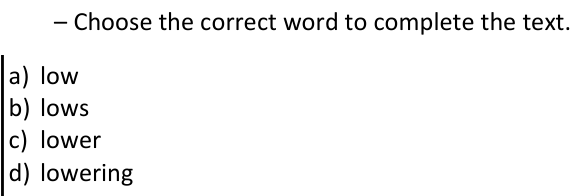
— Choose the correct word to complete the text.
- Alow
- Blows
- Clower
- Dlowering
Reportar erro na questão
Resolução comentada
A lacuna está em "If your expenses are __________ than your income". A palavra than indica comparação entre dois elementos: as despesas (expenses) e a renda (income). Em inglês, a comparação de superioridade com adjetivo curto usa o adjetivo no grau comparativo, formado com o sufixo -er seguido de than.
Passos:
- A estrutura é "adjetivo + than", então precisamos de um comparativo.
- O adjetivo curto "low" (baixo) forma o comparativo acrescentando -er: \text{low} \rightarrow \text{lower}.
- O sentido também confere: se as despesas são menores que a renda, sobra dinheiro. O texto confirma isso na frase seguinte: "Now you know how much money you have left to spend each month" (agora você sabe quanto dinheiro sobra para gastar por mês). Por isso a pessoa está "on the right road".
A frase completa fica: "If your expenses are lower than your income, you are on the right road!"
As outras opções não funcionam: "low" está no grau positivo e não combina com "than"; "lows" é um substantivo no plural; "lowering" é uma forma verbal em -ing, que não cabe depois de "are" com o sentido de comparação.
Alternativa C.
Por que as outras alternativas estão erradas
- A"low" está no grau positivo e não pode ser seguido de "than" em uma comparação.
- B"lows" é substantivo no plural, que não completa a comparação entre despesas e renda.
- D"lowering" é forma em -ing (verbo), não é comparativo do adjetivo e não faz sentido com "than".
Assunto: Classes de palavras.
Reportar erro na resolução
Ver como caiu na prova
Fonte: EEAR 2025 · CFS 2. Prova oficial ↗