PRÁTICA COM QUESTÕES OFICIAIS
Questão 31 (CFS 1) da EEAR 2024
Read the text and answer questions 28, 29, 30 and 31. · CFS 1
The pursuit of happiness can end in pain
Maggie Mulqueen, psychologist
Focusing on happiness can lead to perfectionistic tendencies as people try to sustain what is actually a brief and elusive emotion. Instead of promoting happiness as the elixir for life, our society needs to explore how people can find contentment. Unlike happiness, a state of contentment is long-lasting and provides a strong base for mental health. Discovering what makes us feel content and pursuing that help protect us from stress. The pressure people feel to be happy can also be corrosive to establishing a strong sense of self. A patient of mine recently lost 75 pounds. Everyone who sees her congratulates her and expects her to be happy about this accomplishment. Rather than being supported by all these compliments, she feels tremendous pressure to present a happy face to the outside world. How gratifying it ___________ for her if people asked “How do you feel?” rather than stating “You must be so happy!”
Adapted from https://www.nbcnews.com/think/opinion/suicide-student-athletes-happiness-contentment-rcna27992.
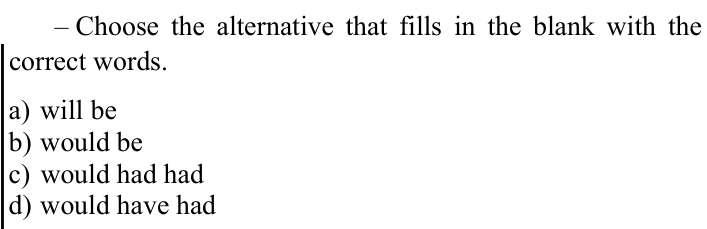
– Choose the alternative that fills in the blank with the correct words.
- Awill be
- Bwould be
- Cwould had had
- Dwould have had
Reportar erro na questão
Resolução comentada
A lacuna está na última frase: How gratifying it ______ for her if people asked “How do you feel?” rather than stating “You must be so happy!”
O conceito é a estrutura condicional. Repare no verbo da oração com if: asked, passado simples. Isso caracteriza o second conditional (segundo condicional), usado para situações hipotéticas ou improváveis no presente/futuro:
Passos:
- A oração com if traz asked (passado simples), então a outra oração deve trazer would + verbo base.
- O verbo da lacuna é to be, pois a frase é how gratifying it ___ for her ("como seria gratificante para ela").
- Logo, a forma é would be.
Veja por que as outras não servem: will be é futuro real, que exigiria if + presente (if people ask). Já would have had seria o third conditional, que pede if + past perfect (if people had asked), referindo-se a algo passado. Would had had nem existe em inglês, pois depois de would o verbo fica no infinitivo sem to.
A frase fica: How gratifying it would be for her if people asked... ("Como seria gratificante para ela se as pessoas perguntassem...").
Alternativa B.
Por que as outras alternativas estão erradas
- Awill be é do first conditional e exigiria if + presente, mas o texto traz asked (passado).
- Cwould had had é uma construção inexistente, pois após would o verbo não vai no passado.
- Dwould have had é do third conditional, que exigiria if + past perfect (had asked).
Assunto: Tempos verbais e verbos modais.
Reportar erro na resolução
Ver como caiu na prova
Fonte: EEAR 2024 · CFS 1. Prova oficial ↗