PRÁTICA COM QUESTÕES OFICIAIS
Questão 29 (CFS 1) da EEAR 2023
Read the text and answer questions 29 and 30. · CFS 1
Ben
Michael Jackson
Ben, the two of us need look no more
We both found what we were looking for
with a friend to call my own
I will never be alone
And you, my friend, will see
you have got a friend in me
Ben, you are always running here and there
You feel you are not wanted anywhere
If you ever look behind and don’t like what you will find
There’s something you should know
You have got a place to go
I used to say “I” and “Me”
Now it’s us, now it’s we
Ben, most people would turn you away...
www.vagalume.com.br.
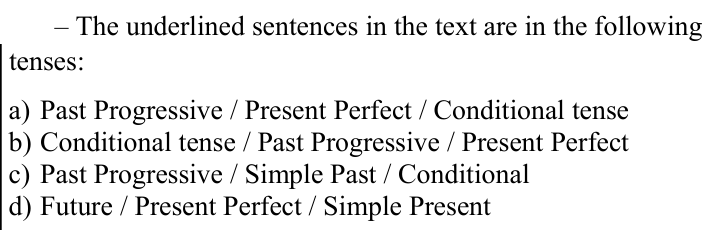
– The underlined sentences in the text are in the following tenses:
- APast Progressive / Present Perfect / Conditional tense
- BConditional tense / Past Progressive / Present Perfect
- CPast Progressive / Simple Past / Conditional
- DFuture / Present Perfect / Simple Present
Reportar erro na questão
Resolução comentada
Identifique o tempo verbal de cada trecho sublinhado, na ordem em que aparecem.
-
we were looking for: "were" (passado de to be) + verbo com -ing forma o Past Progressive (ação em andamento no passado).
-
You have got a place to go: "have got" é have + particípio (got), ou seja, Present Perfect. Na prática "have got" equivale a "have" (posse), mas a estrutura gramatical é a do Present Perfect.
-
most people would turn you away: "would" + verbo na forma base (turn) forma o Conditional, que indica hipótese ou possibilidade.
A sequência é: Past Progressive / Present Perfect / Conditional.
As demais alternativas erram ao trocar a ordem ou ao classificar "have got" e "would turn" como Simple Past, Future ou Simple Present.
Alternativa A.
Pegadinha: A alternativa C engana ao tratar "have got" como Simple Past por causa do "got", que parece passado, mas aqui é particípio do Present Perfect.
Por que as outras alternativas estão erradas
- BInverte a ordem: o primeiro trecho é Past Progressive, não Conditional, e o último é Conditional, não Present Perfect.
- CClassifica "have got" como Simple Past, mas é Present Perfect (have + particípio).
- D"were looking" não é Future, "have got" não é Simple Present nem "would turn" é Present Perfect; todos os três tempos estão errados.
Assunto: Tempos verbais e verbos modais.
Reportar erro na resolução
Ver como caiu na prova
Fonte: EEAR 2023 · CFS 1. Prova oficial ↗