PRÁTICA COM QUESTÕES OFICIAIS
Questão 46 (CFS 1) da EEAR 2022
Read the text and answer questions 46, 47 and 48. · CFS 1
Ancient mummies unearthed in Egypt after more than 2,600 years
Charlene Gubash and Adela Suliman
More than 2,600 years since they were buried, archaeologists in Egypt said Saturday they had found at least 59 ancient coffins in a vast necropolis south of the country’s capital Cairo, one containing the pristine mummy of an ancient priest.
The ornate sarcophagi have remained unopened since they were entombed near the famed Step Pyramid of Djoser in Saqqara, according to Egypt’s Ministry of Tourism and Antiquities.
Footage shared by the ministry showed colorful sarcophagi decorated with ancient Egyptian hieroglyphics. Other artifacts and at least 28 statues were found in the two deep wells, the ministry said.
A sealed door was also unearthed where it is expected more mummies may lie behind, said Khaled el-Anany the first Minister of Antiquities and Tourism, adding that the artifacts were in an excellent state of preservation and would be displayed in the Grand Egyptian museum next year.
Mostafa Waziri, the general director of Egypt’s Supreme Council of Antiquities, told NBC News that the find reminded him of the tomb of King Tutankhamun, because both had been discovered almost intact.
The Saqqara plateau is part of the necropolis of Egypt’s ancient city of Memphis. Designated a UNESCO World Heritage site in 1970s, it includes the famed Giza Pyramids. It is also home to tombs created across thousands of years between the 1st Dynasty (2920 B.C.-2770 B.C.) and the Coptic period (395-642).
Hundreds of mummified animals, birds and crocodiles, as well as two mummified lion cubs were found in the region last year.
Last week, the ministry displayed a bronze statue of the god “Nefertam” one of the artifacts discovered with the ancient wooden coffins.
“Saqqara antiquities area is still revealing its secrets,” the ministry said.
Adapted from https://www.nbcnews.com
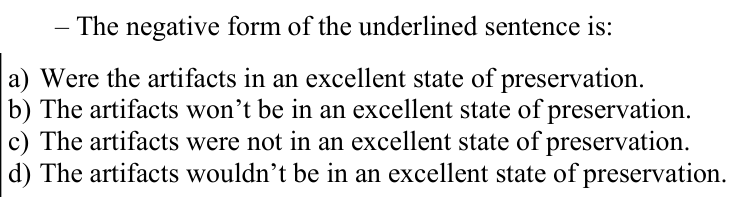
– The negative form of the underlined sentence is:
- AWere the artifacts in an excellent state of preservation.
- BThe artifacts won’t be in an excellent state of preservation.
- CThe artifacts were not in an excellent state of preservation.
- DThe artifacts wouldn’t be in an excellent state of preservation.
Reportar erro na questão
Resolução comentada
A frase sublinhada é the artifacts were in an excellent state of preservation. O verbo está no passado simples do verbo to be (were, de were/was).
Para negar uma frase com o verbo to be, não usamos auxiliar: basta colocar not logo depois do verbo, mantendo a ordem sujeito + verbo.
- Frase original: The artifacts were in an excellent state of preservation.
- Acrescentamos not após o verbo: The artifacts were not in an excellent state of preservation.
- Forma contraída: weren't.
As demais opções mudam a estrutura ou o tempo verbal. A inversão entre sujeito e verbo (Were the artifacts...) forma pergunta, não negação. Já won't be é futuro e wouldn't be é condicional, e nenhum dos dois mantém o passado da frase original.
Alternativa C.
Por que as outras alternativas estão erradas
- AInverte sujeito e verbo, formando uma pergunta (afirmativa), não uma negação.
- BNega no futuro (won't be), mudando o tempo verbal do passado.
- DUsa o condicional (wouldn't be), que não corresponde ao passado simples original.
Assunto: Tempos verbais e verbos modais.
Reportar erro na resolução
Ver como caiu na prova
Fonte: EEAR 2022 · CFS 1. Prova oficial ↗