PRÁTICA COM QUESTÕES OFICIAIS
Questão 43 (CFS 1) da EEAR 2022
Read the text and answer questions 43 and 44. · CFS 1
Fires and Hurricanes
In the US, fires burn in the west. Also, hurricanes hit the east. However, extreme weather is more and more usual in all of the world.
Scientists think that human activity brings more extreme weather. The planet is getting warmer.
A study finds that people are responsible for 97% of fires in the US. Warmer temperatures mean more fires. The fires start very easily. They are bigger. It is harder to stop them.
Warmer temperatures also make more hurricanes. The hurricanes are stronger. It is more common that they get the land. They break up houses. They kill people, too. Scientists expect more hurricanes this year. The hurricane season ends on November 30th.
https://www.newsinlevels.com/products/fires-and-hurricanes-level-1/
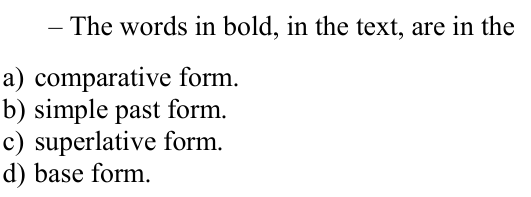
– The words in bold, in the text, are in the
- Acomparative form.
- Bsimple past form.
- Csuperlative form.
- Dbase form.
Reportar erro na questão
Resolução comentada
As palavras em negrito são warmer, bigger, harder e stronger. Para identificar a forma, observe como o adjetivo foi construído.
- Os adjetivos curtos (uma sílaba) formam o comparativo de superioridade acrescentando -er: warm \to warmer, big \to bigger (com a consoante dobrada), hard \to harder, strong \to stronger.
- O superlativo de adjetivos curtos usa the + -est (the warmest, the biggest). Nenhuma das palavras tem essa terminação nem vem com the.
- O passado simples é formado por verbos com -ed ou formas irregulares. Aqui são adjetivos, não verbos.
- A forma base seria warm, big, hard, strong, sem sufixo.
O texto também confirma o sentido comparativo: temperaturas mais quentes (warmer) geram incêndios maiores (bigger) e furacões mais fortes (stronger), ou seja, em comparação com o que era antes. Também é mais difícil (harder) apagá-los.
Portanto, todas as palavras em negrito estão no comparativo.
Alternativa A.
Por que as outras alternativas estão erradas
- BWarmer, bigger, harder e stronger são adjetivos, não verbos no passado simples.
- CO superlativo exigiria -est e o artigo the (the warmest, the biggest).
- DA forma base seria sem sufixo (warm, big, hard, strong).
Assunto: Classes de palavras.
Reportar erro na resolução
Ver como caiu na prova
Fonte: EEAR 2022 · CFS 1. Prova oficial ↗