PRÁTICA COM QUESTÕES OFICIAIS
Questão 36 (CFS 1) da EEAR 2021
Read the text and answer questions 36 and 37. · CFS 1
In The End
Linkin Park
One thing, I don’t know why
It doesn’t even matter how hard you try
Keep that in mind
I designed this rhyme
To remind myself of a time when
I tried so hard
In spite of the way you were mocking me
Acting like I was part of your property
Remembering all the times you fought with me
I’m surprised it got so
Things aren’t the way they were before
You wouldn’t even recognize me anymore
Not that you knew me back then
But it all comes back to me in the end
You kept everything inside
And even though I tried, it all fell apart
What it meant to me will eventually be a memory of a time when
I tried so hard
And got so far
But in the end
It doesn’t even matter
I had to fall
To lose it all
But in the end
It doesn’t even matter
I’ve put my trust in you
Pushed as far as I can go
For all this
There’s only one thing you should know
I’ve put my trust in you
Pushed as far as I can go
For all this
There’s only one thing you should know
https://www.vagalume.com.br/linkin-park/in-the-end.html
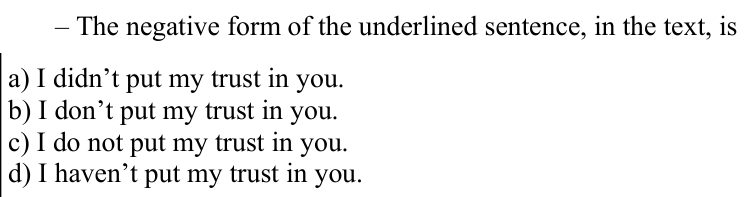
– The negative form of the underlined sentence, in the text, is
- AI didn’t put my trust in you.
- BI don’t put my trust in you.
- CI do not put my trust in you.
- DI haven’t put my trust in you.
Reportar erro na questão
Resolução comentada
A frase sublinhada é "I've put my trust in you". O "'ve" é a contração de have, auxiliar do present perfect (have + particípio passado: put é o particípio de to put, que é irregular e não muda).
Para negar o present perfect, basta acrescentar not ao auxiliar: have not ou, na forma contraída, haven't.
- Afirmativa: I have put my trust in you.
- Negativa: I have not (haven't) put my trust in you.
Não se usa do/did para negar o present perfect, porque o auxiliar já é have.
As demais opções mudam o tempo verbal:
- "I didn't put" está no passado simples;
- "I don't put" e "I do not put" estão no presente simples.
Só a opção que mantém o present perfect preserva o tempo verbal original.
Alternativa D.
Por que as outras alternativas estão erradas
- AUsa o passado simples (didn't put), que muda o tempo verbal do present perfect.
- BUsa o presente simples negativo (don't put), tempo diferente do original.
- CÉ a forma por extenso do presente simples (do not put), também com tempo verbal trocado.
Assunto: Tempos verbais e verbos modais.
Reportar erro na resolução
Ver como caiu na prova
Fonte: EEAR 2021 · CFS 1. Prova oficial ↗