PRÁTICA COM QUESTÕES OFICIAIS
Questão 29 (CFS 2) da EEAR 2021
Read the text and answer question 29. · CFS 2
The Chronicles of Narnia - The Lion, the Witch and the
Wardrobe
The Lion, the Witch and the Wardrobe, completed by the end of March 1949 and published by Geoffrey Bles in the United Kingdom on 16 October 1950, tells the story of four ordinary children: Peter, Susan, Edmund, and Lucy Pevensie, who ______________ evacuated to the English countryside from London following the outbreak of World War II. They discover a wardrobe in Professor Digory Kirke’s house that leads to the magical land of Narnia. The Pevensie children help Aslan, a talking lion, save Narnia from the evil White Witch, who has reigned over the land of Narnia for a century of perpetual winter with no Christmas. The children become kings and queens of this new-found land and establish the Golden Age of Narnia, leaving a legacy to be rediscovered in later books.
Adapted from www.en.wipedia.org/wiki/the_lion_the_witch_and_the_wardrobe
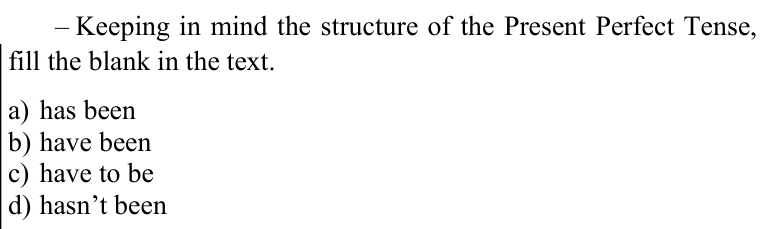
– Keeping in mind the structure of the Present Perfect Tense, fill the blank in the text.
- Ahas been
- Bhave been
- Chave to be
- Dhasn’t been
Reportar erro na questão
Resolução comentada
O Present Perfect é formado por have/has + particípio passado. Para escolher entre have e has, olhe o sujeito da oração.
- O verbo da lacuna tem como sujeito o pronome relativo who, que retoma four ordinary children: Peter, Susan, Edmund, and Lucy. Portanto, o sujeito é plural (quatro crianças) e pede have.
- A lacuna é seguida de evacuated, que é particípio. Assim, a estrutura precisa ser have been evacuated, a voz passiva no Present Perfect: have + been + particípio.
- O sentido também confirma: as crianças "foram evacuadas" de Londres para o campo após o início da guerra. Não faz sentido negar a frase, pois a história começa justamente com essa evacuação.
Testando as opções:
- has been concordaria com sujeito singular, o que não é o caso.
- have to be indica obrigação ("têm que ser") e não é Present Perfect.
- hasn't been é negativa e singular.
A frase completa fica: "...who have been evacuated to the English countryside from London...".
Alternativa B.
Por que as outras alternativas estão erradas
- AUsa has, que concorda com sujeito singular, mas o sujeito (who = four children) é plural.
- CHave to be expressa obrigação e não forma o Present Perfect pedido.
- DÉ negativa e singular, contrariando o sentido (as crianças foram evacuadas) e a concordância.
Assunto: Tempos verbais e verbos modais.
Reportar erro na resolução
Ver como caiu na prova
Fonte: EEAR 2021 · CFS 2. Prova oficial ↗