PRÁTICA COM QUESTÕES OFICIAIS
Questão 36 (CFS 1) da EEAR 2020
Read the text to answer questions 34, 35 and 36. · CFS 1
Back to School
For generations in the United States, a nineteenth century invention known as the public school system was seen as the best way to give students the knowledge and skills to become nice citizens. Around the 1960s, experts began questioning the system, citing the need for new types of schools to meet the changing demands of the twentieth century. These reformers eventually won for parents a much broader range of educational choices – including religious, alternative, and charter schools and home schooling – but they also sparked a debate on teaching and learning that still divides experts to this day.
Nunan, David - Listen in book 2, second edition.
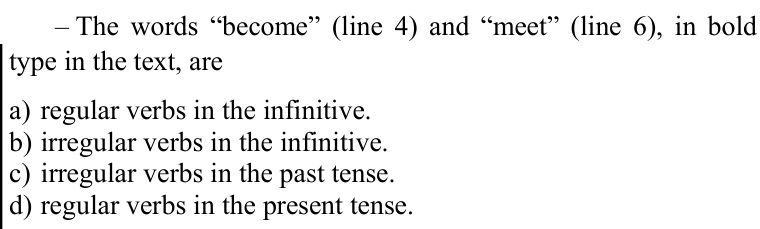
– The words “become” (line 4) and “meet” (line 6), in bold type in the text, are
- Aregular verbs in the infinitive.
- Birregular verbs in the infinitive.
- Cirregular verbs in the past tense.
- Dregular verbs in the present tense.
Reportar erro na questão
Resolução comentada
Observe como cada verbo aparece no texto:
- "to become nice citizens": depois de "to", o verbo está no infinitivo.
- "to meet the changing demands": de novo, "to" + verbo, ou seja, infinitivo.
Agora, regular ou irregular? Verbos regulares formam o passado e o particípio com -ed. Já os irregulares mudam de forma:
- become → became → become
- meet → met → met
Como nenhum dos dois forma o passado com -ed, ambos são irregulares.
Logo, "become" e "meet" são verbos irregulares no infinitivo. Não estão no passado: "became" e "met" seriam as formas de passado, e o texto traz as formas base, precedidas de "to". Também não estão no presente simples, pois não há sujeito concordando com o verbo, e sim o infinitivo com "to".
Alternativa B.
Por que as outras alternativas estão erradas
- Aos verbos estão no infinitivo, mas não são regulares, pois o passado não se forma com -ed (became, met).
- Cas formas de passado seriam "became" e "met"; no texto aparecem as formas base, após "to".
- Dnão são regulares nem estão no presente: aparecem após "to", como infinitivo.
Assunto: Tempos verbais e verbos modais.
Reportar erro na resolução
Ver como caiu na prova
Fonte: EEAR 2020 · CFS 1. Prova oficial ↗