PRÁTICA COM QUESTÕES OFICIAIS
Questão 29 (CFS 1) da EEAR 2016
Read the text and answer questions 28, 29 and 30. · CFS 1
The Greenhouse Effect
A greenhouse is a house made of glass. The sun shines right through the glass and makes it warm inside the greenhouse. It is possible to grow flowers and vegetables inside a greenhouse in the winter. Scientists have a theory that a lot of carbon dioxide in the atmosphere will act like the glass in a greenhouse. As the sun shines through the carbon dioxide blanket, the atmosphere will get hotter and hotter.
Carbon dioxide is produced by combustion, the burning of fuel. It is being added to the normal atmosphere as we have more and more cars, more and more houses and industries. In short, more people produce more carbon dioxide.
Scientists predict that as a result of more carbon dioxide in the atmosphere, there will be a global warming, or a long-term rise in temperatures over the earth.
(Adapted from “Time and Space”)
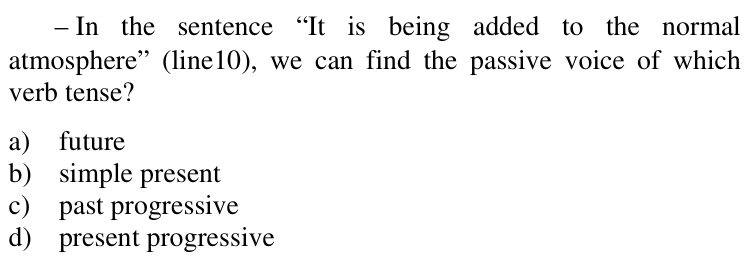
– In the sentence “It is being added to the normal atmosphere” (line10), we can find the passive voice of which verb tense?
- Afuture
- Bsimple present
- Cpast progressive
- Dpresent progressive
Você já respondeu questões neste aparelho. Crie sua conta grátis para guardar o histórico e refazer as que errou.
Resposta salva no seu histórico.
Reportar erro na questão
Resolução comentada
Para identificar o tempo verbal da voz passiva, basta lembrar a fórmula: verbo to be no mesmo tempo da frase ativa + particípio passado.
Na frase "It is being added", temos:
- is: verbo to be no presente;
- being: gerúndio de to be, que indica ação em andamento;
- added: particípio do verbo add.
A estrutura "am/is/are + being + particípio" é a passiva do present progressive (presente contínuo).
Para conferir, passe a frase para a voz ativa: "We are adding carbon dioxide to the atmosphere". Aqui aparece "are adding" (to be no presente + verbo com -ing), que é exatamente o present progressive.
Os outros tempos teriam estruturas diferentes na passiva:
- simple present: "is added";
- past progressive: "was being added";
- future: "will be added".
Como o texto fala de algo que está acontecendo agora ("as we have more and more cars..."), o sentido de ação em andamento também confirma a escolha.
Alternativa D.
Por que as outras alternativas estão erradas
- AO futuro na voz passiva seria "will be added"; a frase não tem "will".
- BO simple present passivo seria "is added", sem o "being".
- CO past progressive passivo seria "was/were being added"; aqui o verbo "is" está no presente.
Assunto: Tempos verbais e verbos modais.
Reportar erro na resolução
Ver como caiu na prova
Fonte: EEAR 2016 · CFS 1. Prova oficial ↗