PRÁTICA COM QUESTÕES OFICIAIS
Questão 26 (CFS 1) da EEAR 2016
Read the extract and answer questions 25, 26 and 27. · CFS 1
“Miss Emlyn read us some of it. I asked Mummy to read some more. I liked it. It has a wonderful sound. A brave new world. There isn’t anything really like that, is there?” “You don’t believe in it?” “Do you?” “There is always a brave new world”, said Poirot, “but only, you know, for very special people. The lucky ones. The ones who carry the making of that world within ________.”
(Adapted from Agatha Christie, Hallowe’en Party)
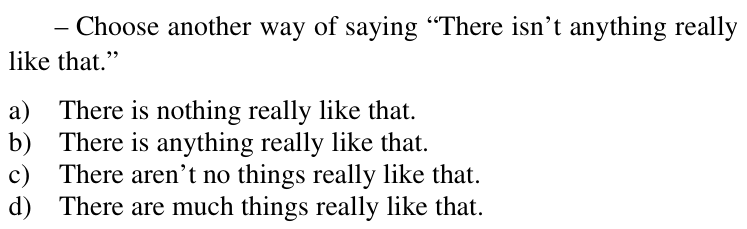
– Choose another way of saying “There isn’t anything really like that.”
- AThere is nothing really like that.
- BThere is anything really like that.
- CThere aren’t no things really like that.
- DThere are much things really like that.
Você já respondeu questões neste aparelho. Crie sua conta grátis para guardar o histórico e refazer as que errou.
Resposta salva no seu histórico.
Reportar erro na questão
Resolução comentada
A frase original, "There isn't anything really like that", é uma negação com o verbo to be e o pronome indefinido anything. Em inglês, a negação pode vir de duas formas equivalentes: not ... anything (negação no verbo + anything) ou nothing (pronome já negativo, com verbo afirmativo).
Assim:
- There isn't anything = There is nothing. O sentido é "não há nada".
- O restante, "really like that" ("realmente parecido com isso"), permanece igual.
Logo, a reescrita equivalente é "There is nothing really like that."
Confira as outras opções: anything em frase afirmativa muda o sentido, e aren't no gera dupla negação, que em inglês padrão anula a negação ou soa incorreta. Much não se usa com substantivo contável no plural (things), e a frase ainda seria afirmativa, contrariando o sentido original.
Alternativa A.
Por que as outras alternativas estão erradas
- BUsa "anything" em frase afirmativa, o que a torna incoerente e muda o sentido: afirma que existe algo parecido.
- CDupla negação ("aren't no") e concordância errada; em inglês padrão não equivale à frase original.
- D"Much" não se usa com contáveis no plural (seria "many") e a frase é afirmativa, invertendo o sentido.
Assunto: Referência pronominal e pronomes.
Reportar erro na resolução
Ver como caiu na prova
Fonte: EEAR 2016 · CFS 1. Prova oficial ↗