PRÁTICA COM QUESTÕES OFICIAIS
Questão 48 (CFS 2) da EEAR 2009
Read the passage and answer questions 46, 47, 48 and 49. · CFS 2
Before the second World War, travel was difficult to organize, expensive and sometimes dangerous. Nowadays, people can easily organize their next trip anywhere in the world through a travel agent. If you shop around, many travel agents can offer you cheap package tours to many popular destinations depending on the season. Air travel is generally more expensive towards the end of the year, during the Christmas and holiday season. This is the peak period for travel, and people often make travel reservations several months in advance. If you want to avoid peak travel periods, make your travel arrangements during the off-peak periods. Off-peak periods are a good time to travel as it is usually quieter and cheaper. Sometimes, you can get air, sea or train tickets to see many popular tourist attractions in the world for half price! Many young people try to avoid the crowd when they travel, and they often prefer to travel off the beaten track. They often have shoestring budgets and travel by hitch-hiking rather than public transport. They also like to stay at youth hostels and meet other young travellers. Older people and families often have a bigger budget. They usually like to go on packaged tours and have all of their travel arrangements organized by the tour operator. Families prefer to book their holidays at a resort, often near a lake or close to the beach, where there are lots of activities for the children to enjoy.
GLOSSARY:
avoid: evitar
off the beaten track: lugar onde poucas vão
budget: orçamento
shoestring : com pouco dinheiro
youth hostel : albergue
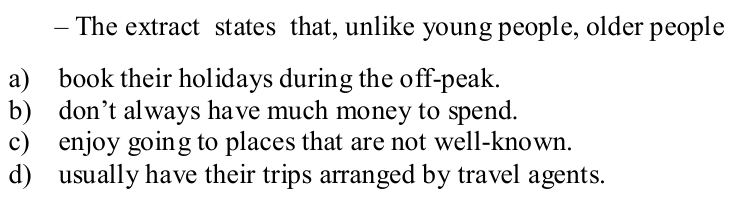
– The extract states that, unlike young people, older people
- Abook their holidays during the off-peak.
- Bdon’t always have much money to spend.
- Cenjoy going to places that are not well-known.
- Dusually have their trips arranged by travel agents.
Você já respondeu questões neste aparelho. Crie sua conta grátis para guardar o histórico e refazer as que errou.
Resposta salva no seu histórico.
Reportar erro na questão
Resolução comentada
A pergunta pede o contraste que o texto faz entre jovens e pessoas mais velhas. Vamos ver o que o último parágrafo diz sobre cada grupo.
Sobre os jovens: eles evitam multidões, preferem lugares "off the beaten track", têm orçamentos apertados ("shoestring budgets"), viajam de carona e ficam em albergues.
Sobre os mais velhos: "Older people and families often have a bigger budget. They usually like to go on packaged tours and have all of their travel arrangements organized by the tour operator." Ou seja, têm orçamento maior e costumam contratar pacotes, com toda a viagem organizada pela operadora de turismo.
Agora as alternativas:
- (A) O texto não associa as férias fora de temporada aos mais velhos.
- (B) Diz o contrário: os mais velhos têm orçamento maior.
- (C) Lugares pouco conhecidos são a preferência dos jovens.
- (D) Viagens organizadas por quem vende pacotes correspondem ao que se diz dos mais velhos, em contraste com os jovens, que viajam por conta própria, de carona.
A ideia de "viagem arranjada por terceiros" é a que opõe os dois grupos. A palavra "tour operator" é o equivalente mais próximo de "travel agents" da alternativa D.
Alternativa D.
Por que as outras alternativas estão erradas
- AO texto não diz que os mais velhos viajam fora de temporada; essa dica é dada ao leitor em geral.
- BInverte o texto: os mais velhos têm orçamento maior, e quem tem pouco dinheiro são os jovens.
- CViajar por lugares pouco conhecidos (off the beaten track) é característica dos jovens, não dos mais velhos.
Assunto: Informações explícitas e detalhes.
Reportar erro na resolução
Ver como caiu na prova
Fonte: EEAR 2009 · CFS 2. Prova oficial ↗