PRÁTICA COM QUESTÕES OFICIAIS
Questão 45 (CFS 2) da EEAR 2009
Read the text and answer questions 44 and 45. · CFS 2
The Horse and the Donkey
One day, a man went on a journey, and took with him his horse and his donkey. He put a very heavy load on the donkey’s back, but nothing on the horse’s back. After a while, the poor donkey ___ the horse to help him. But the horse, who was very selfish, refused.
Further along the road, the donkey started to feel very tired, and again ___ the horse to take some of the load. And again the horse ___.
Finally, the donkey fell exhausted at the side of the road and died. So the man took the whole of the heavy load and put it on the horse’s back, together with the skin of the dead donkey, and they continued on their journey.
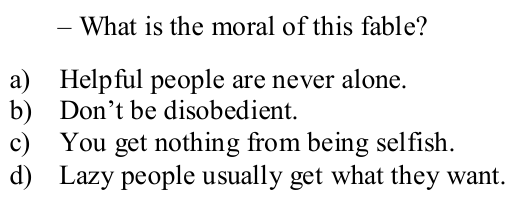
– What is the moral of this fable?
- AHelpful people are never alone.
- BDon’t be disobedient.
- CYou get nothing from being selfish.
- DLazy people usually get what they want.
Você já respondeu questões neste aparelho. Crie sua conta grátis para guardar o histórico e refazer as que errou.
Resposta salva no seu histórico.
Reportar erro na questão
Resolução comentada
A pergunta pede a moral da fábula, isto é, a lição que a história ensina. Para achá-la, siga os fatos do texto:
- O burro carrega uma carga muito pesada e o cavalo não carrega nada.
- O burro pede ajuda ao cavalo, que é very selfish ("muito egoísta") e recusa duas vezes.
- O burro cai exausto e morre.
- O homem coloca toda a carga no cavalo, junto com a pele do burro morto.
O cavalo queria evitar o esforço e não dividiu um pouco do peso. No fim, acabou com a carga inteira, mais o peso extra da pele do burro. O egoísmo, portanto, não lhe trouxe vantagem nenhuma, só prejuízo.
Isso corresponde a You get nothing from being selfish ("você não ganha nada sendo egoísta").
As demais opções falam de temas que não aparecem na história: ninguém é desobediente, o cavalo não é recompensado e a ideia de nunca estar sozinho não é discutida.
Alternativa C.
Por que as outras alternativas estão erradas
- AO burro, que pediu ajuda, acabou sozinho e morto; o texto não trata de pessoas prestativas nunca ficarem sós.
- BNão há desobediência na história: ninguém descumpre ordens.
- DO cavalo, que evitou o trabalho, acaba com a carga toda; ele não consegue o que quer.
Assuntos: Poemas, canções e textos literários, Inferência e ponto de vista do autor.
Reportar erro na resolução
Ver como caiu na prova
Fonte: EEAR 2009 · CFS 2. Prova oficial ↗