Questão 9 da UNICAMP 2020
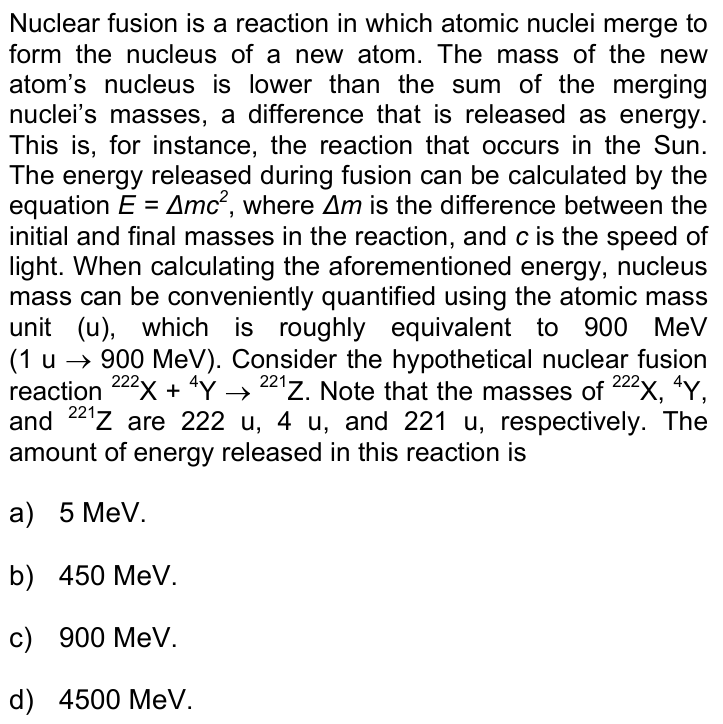
Nuclear fusion is a reaction in which atomic nuclei merge to form the nucleus of a new atom. The mass of the new atom’s nucleus is lower than the sum of the merging nuclei’s masses, a difference that is released as energy. This is, for instance, the reaction that occurs in the Sun. The energy released during fusion can be calculated by the equation E = \Delta mc^2, where \Delta m is the difference between the initial and final masses in the reaction, and c is the speed of light. When calculating the aforementioned energy, nucleus mass can be conveniently quantified using the atomic mass unit (u), which is roughly equivalent to 900\ \text{MeV} (1\ \text{u} \rightarrow 900\ \text{MeV}). Consider the hypothetical nuclear fusion reaction {}^{222}\text{X} + {}^{4}\text{Y} \rightarrow {}^{221}\text{Z}. Note that the masses of {}^{222}\text{X}, {}^{4}\text{Y}, and {}^{221}\text{Z} are 222\ \text{u}, 4\ \text{u}, and 221\ \text{u}, respectively. The amount of energy released in this reaction is
- A5\ \text{MeV}.
- B450\ \text{MeV}.
- C900\ \text{MeV}.
- D4500\ \text{MeV}.
Reportar erro na questão
Ver como caiu na prova