Questão 9 (2º semestre) do São Camilo 2026
Leia o texto para responder às questões de 06 a 10. · Prova II
1 More and more we’re exposed to vast amounts of information and highly sophisticated software that offers to do the thinking for us. In just a few seconds, tools such as ChatGPT or Gemini can draft your emails, generate a birthday message for a friend, or even summarise the plot of a novel you haven’t gotten around to reading. Such increased offloading1 has raised the concern that people will become excessively dependant on AI. This could have unplanned consequences, such as eroding our critical thinking skills and declining our overall cognitive ability.
This fear is justified. Research has suggested the online environment exploits our cognitive tendencies — individual differences in how we think, perceive, and remember. In turn, some people only engage with information superficially. Studies have also linked high AI use to increased laziness, anxiety, lower critical engagement and feelings of dependence.
Yet it may be how we use AI that’s the problem, rather than the fact we do it at all.
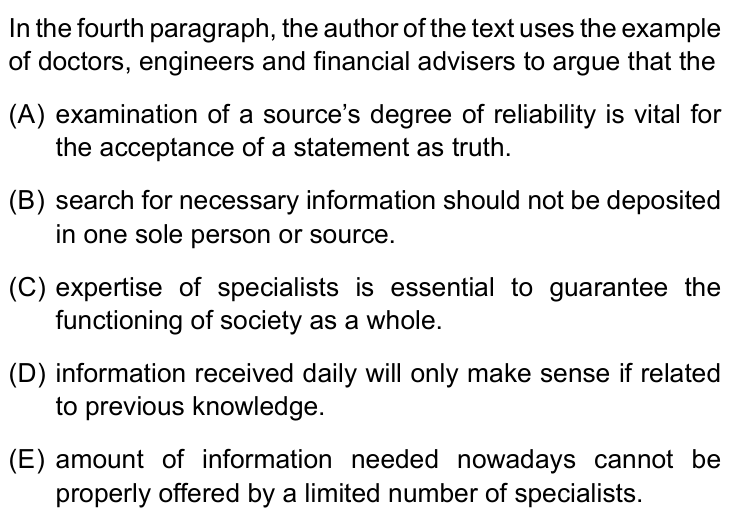
Generally, relying on external sources is fine. We all constantly count on each other’s knowledge to function as a society. Doctors provide medical information, engineers are in charge of construction, financial advisers give investment tips, and so on. All this spread of expertise provides each of us with more knowledge than we can individually hold. More importantly, we don’t offload all thinking tasks to one specific person. Instead, we carefully consider the person’s trust and expertise before accepting their advice or support. We also check how the new information fits in with what we already know.
5 As our knowledge grows in a certain area, we rely less on outside support, just as a student relies on a teacher until they learn enough to stand on their own.
(Misia Temler. http://theconversation.com, 09.03.2026. Adaptado.)
1to offload: to transfer (a task or information) to something or someone else.
In the fourth paragraph, the author of the text uses the example of doctors, engineers and financial advisers to argue that the
- Aexamination of a source’s degree of reliability is vital for the acceptance of a statement as truth.
- Bsearch for necessary information should not be deposited in one sole person or source.
- Cexpertise of specialists is essential to guarantee the functioning of society as a whole.
- Dinformation received daily will only make sense if related to previous knowledge.
- Eamount of information needed nowadays cannot be properly offered by a limited number of specialists.
Reportar erro na questão
Ver como caiu na prova
Fonte: São Camilo 2026 · 2º semestre · Prova II. Prova oficial ↗